In the McEwan lab, we are studying Callery pear. This tree was a favorite of home owners and developers for many years, but recently has become a serious problem in natural areas. In fact, Callery pear is now banned in the State of Ohio! You can learn more about Callery pear at this link.
An important way that Callery pear is getting into habitats is through dispersal of the fruits by animals. We hypothesize that birds are a critical aspect of the biology of Callery pear; however, we do not know which birds specifically utilize Callery pear. We want to know more and we need your help.
Calling all birders! We need help from the birding community to understand which birds are eating Callery pear. If you make an observation of Callery pear being eaten by a bird, please upload it into our form (link is below). We will collate all of the information we get and develop a report on which bird species are helping to move this plant into habitats. Also, if you notice any other animal eating the fruits, please upload those images as well! For example, we have found squirrels seem to like the fruits!
If you have any observations of birds, or other wildlife consuming Callery pear, please share them with us at the link below! You will be taken to a google form where you can upload your photo and describe your observation. Happy hunting all!
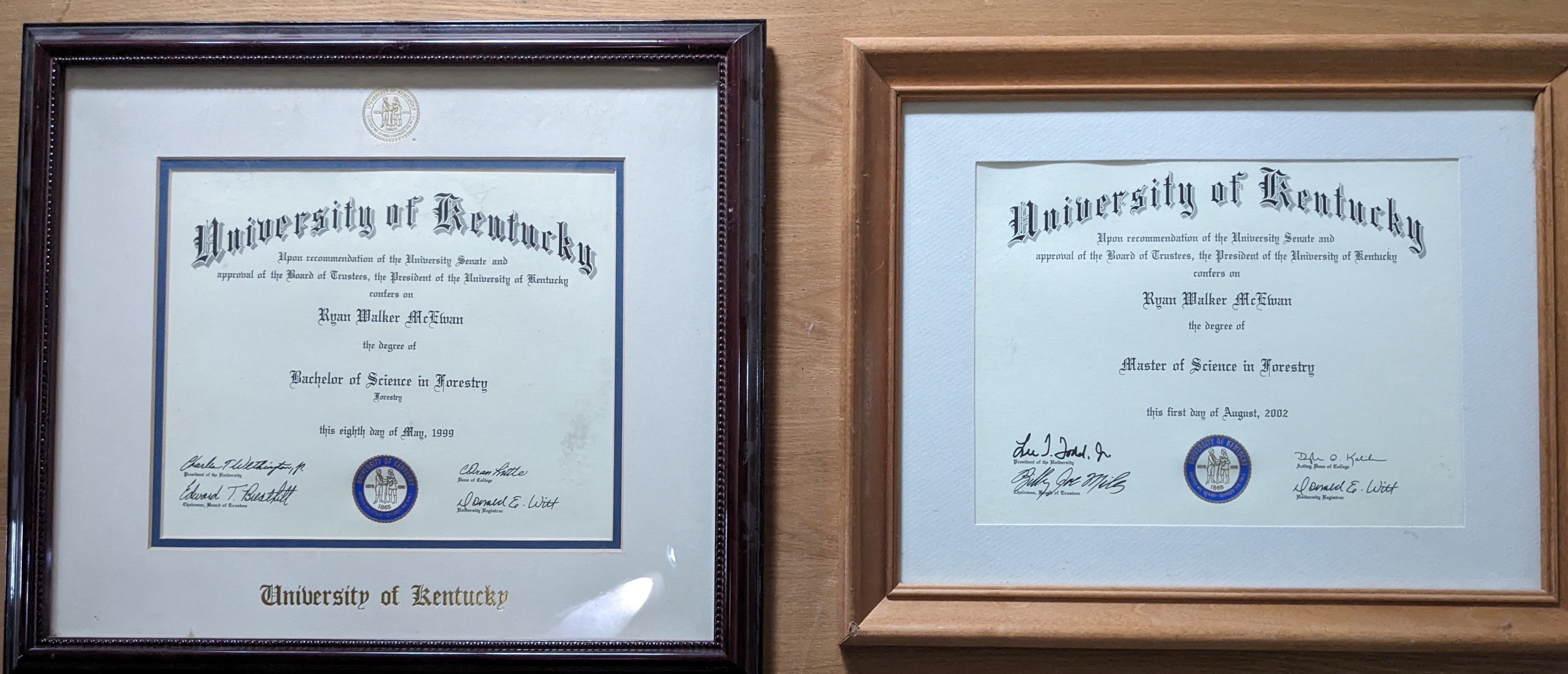
The Bachelors plus Masters (BPM) Program at the University of Dayton is an increasingly popular option for students. This program offers the opportunity to interdigitate your Bachelors degree with an important added credential- a Masters Degree. This can often occur over a 5-year time frame (see details below) so that by adding one year to your BS program you have a significant additional degree. There are very good reasons to become a Master of Science that are outlined in a separate post (HERE). For some students, moving immediately toward this degree while still in undergraduate can be a good choice. Doing a BPM means that you do not have to go through the process of recruiting into a new program once you complete your degree, and given that it overlaps with the undergrad, it can speed up the process by a couple of years.
Scientific Expectations for Students
The expectations for a BPM student are the same for a student who is going through the “traditional” MS program in Biology. This means that the student must complete graduate level coursework, and, more importantly, write a MS Thesis. In the McEwan Lab, our goal for the MS Thesis is to execute a scientific research project that is high-enough quality to lead to a peer-reviewed publication in a respectable journal. Many students have completed their MS in the McEwan Lab, and practically all of these led to a peer-reviewed journal publication. For example, this Thesis by Eric Borth led to this publication, and this Thesis by Meg Maloney contained two chapters that were each published, one focused on Callery pear phenology, the other on management of Callery pear.
The key issue here is that the student who starts down this path is literally trying to become a Master of Science, and thus, they need to be quite serious about the scientific pursuit. This is not just “more undergrad” it is a “different gear” and requires that the student “level-up” their focus and activity.
One aspect of transitioning from the BS process to the MS process is getting adapted to the fact that the Thesis research is the key activity for the MS degree and that, ultimately, their mentor must approve of all aspects of the project. It is not up to the student to “come up with” a MS project – that is an unreasonable expectation for a student, and, frankly, only in extremely rare circumstances would an undergraduate have enough scientific knowledge to be able to design a project on their own that would meet the scientific expectations for obtaining the MS Degree. For these reasons, it is critical that the student stay committed to communication with their adviser so that expectations are clear and the project stays on track. This is complicated, especially during the senior year when “regular” coursework is a major drain on time and focus; however, it is fundamental to success, and if a student really does not feel capable of balancing the needs of undergrad classes with the needs of pursuing scientific mastery, then they should not start the BPM track.
Timeline and Time Commitment Expectations for Students
Students who wish to be involved in a BPM program in Biology at UD would normally get involved in laboratory research as an undergraduate during their Junior year, if not before. The student would engage in research activity in the lab, and may even become a “Project Leader.” This is often associated with an expectation of >15 hours a week committed to a research project that they are actively leading. Generally speaking, a student should demonstrate considerable research initiative and leadership prior to starting the BPM. .
If a student is able to work out the financial and curricula details (see below) and begin the BPM program, the expectation is they will prioritize their research. This will usually include spending the full summer between Junior and Senior year in the lab working on their project. Although different advisers have unique programs, as an example, in the McEwan lab, this normally will amount to approximately 35 hours a week for 12 weeks and run roughly from mid-May to mid-August. Family vacations, etc, are perfectly fine during this time! During the semester of senior year the expectation would be roughly 15-20 hours a week focused on research. Not on classes, not on random UD things, on research. Then during the final year, the student would again be expected to put in roughly 15-20 hours a week, just on research. There may be periods where more time is needed to accomplish the goals of the project. There may be weekends when the student spends a lot of time working on research. There may be holidays when the student spends a lot of time working on research. All of this is flexible and depends on the needs of the student in the moment, and we always emphasize well-being. Even so, it is important that a student have a sense that it takes a lot of dedicated time to becoming a Master of Science.
Curriculum
One of the main constraints on whether a BPM is possible relates to coursework. A student in the BPM must complete the full undergraduate curriculum required of their Bachelor Degree (at UD, normally a Biology or Environmental Biology student, but others are possible), and the full graduate curriculum required for a MS student in Biology. The graduate courses would start the fall semester of the senior year for the student. Some graduate courses can double count for the BS degree, so their is some efficiency between the programs; however, the student will need to have enough time in their schedule to set aside hours for graduate work both fall and spring semester of senior year. This means that the student should come into senior year ahead of schedule in the undergraduate BS program. It also means that planning for courses must be done in specific detail. The Graduate Director in Biology at UD has a spreadsheet that will guide this process and the student must focus on keeping that spreadsheet up to date.
Financial aid and other funding
Nearly all undergraduate students have some kind of financial aid package that helps them afford the undergraduate degree. When a student enters into the BPM program, care is needed to be sure that this financial aid package is not disrupted. This requires some careful work with the adviser and others at UD. It is complicated and every student is unique because their financial aid package is unique as is their course sequence, etc. So the only thing to do is set a meeting and work on it.
The Bachelor plus Masters Program is not associated with a stipend from the University and the student must pay tuition for graduate courses. The cost of the graduate tuition for students in the program is much reduced from the undergraduate tuition rate. Please check with your adviser about these details if you are interested in the program.
Normally, your adviser will cover all of the material expenses associated with your MS Degree work. This will include supplies, travel, and miscellaneous other expenses. The adviser may also provide, through an hourly wage, or through some kind of fellowship, funding for the summer between your Junior and Senior year, and also the summer between Senior year and your final year which will be your “graduate only year” (see timeline, above). In addition, the adviser may be able to provide some hourly-rate funding to work on your research project during the semester in the lab. This is on a case-by-case basis and must not be taken to be an expectation when you begin the program. Again, to be perfectly clear, a BPM student will not be getting a stipend from the University nor will that student receive tuition remission. A BPM student must pay tuition both for senior year and also for the graduate program year.
Joy
A Masters Degree can be characterized by a lot of joy for the student. The science can be exhilarating. Though not required, I encourage any BPM student to do your best to actively pursue happiness during your process.
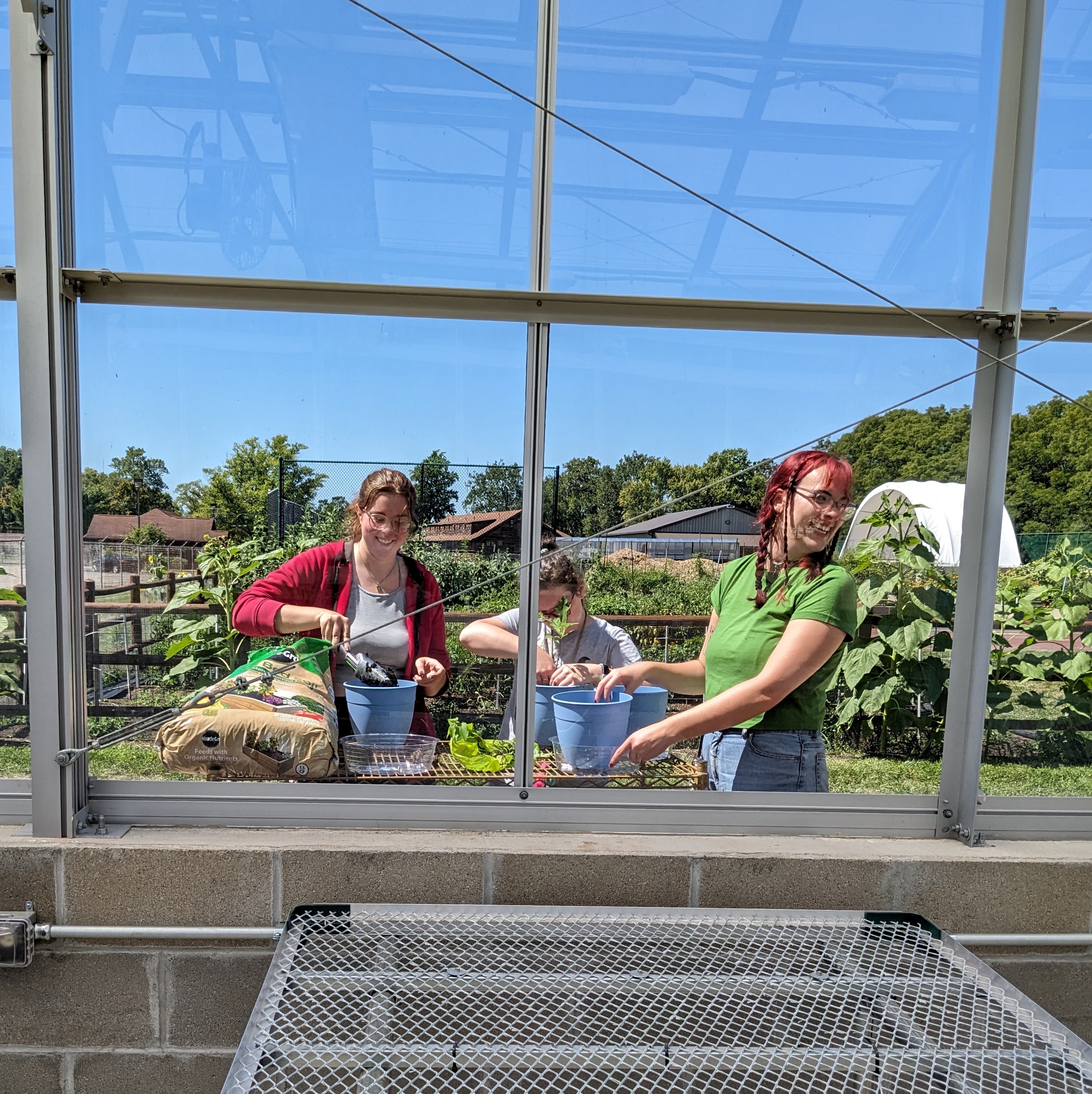
Its an honor and pleasure to be asked to offer a few remarks at the formal opening of this excellent facility. I will divide my comments into three general areas: Gratitude, Centering and Aspiration.
First, I want to express my general gratitude for everyone involved in making this dream become a physical reality. It has been a long journey, by my count, it’s been around 7 years from the initiation of discussions up to today, when we have this lovely, operational, greenhouse. During this time there have been a lot of challenges that we had to overcome including a spike in pressure for greenhouse manufacturing due to medical marijuana becoming legal in Ohio…which actually drove costs up significantly, and, of course, the emergence of COVID-19 which was an existential threat to society in general and was a serious challenge to function here at UD including completing this project. I am grateful to so many people who helped us pull this project through to completion despite these challenges. I want to specifically call out Jen Foster, who I have found to be an inspirational person to work with and who helped us in many ways. Also, our Dean Danielle Poe who prioritized “punching” this project through to completion when she was, surely, flooded with work starting her new position as we came out of COVID. Thanks also to Chelse Prather who has done a great job the last couple of years keeping communication flowing and advocating for the project. And, most importantly, thanks to Rick and the Borth Family for staying patient and eager as we worked through many issues. In a conversation with Rick a while back he mentioned something along the lines that when he was working a “major project” would be completed in a matter of weeks, and so this was a long haul, and I am really grateful for the support overall, and the patience you had in allowing this to come through to completion.
I want to now center our thoughts a bit on what I feel is overarching mission of Ginny’s Garden Greenhouse. Going back to our earliest conversations on this topic, how I have understood Rick’s vision for this facility was that the investment in the building, was really an investment in a bigger vision. Support for the creation of “Ginny’s Garden” was an investment in students. And, specifically, an investment in the transformational power of faculty-mentored experiential learning. In Biology, the research active faculty are inspired by the act of creating miniature communities of scholarship within their research lab. In this model, students who are just getting started in science, for example, as first or second year students, are often mentored not only by the Professor, but also by juniors or seniors in the lab. Additionally, all of these students are mentored by graduate students including TA-funded Masters and PhD students. When Eric Borth was in my lab, he was part of a broader community that included undergraduate students such as Sean Mahoney, Mitch Kukla, Taylor Sparbanie, and, of course, Meg Maloney, along with other undergraduate students. These students were mentored by graduate students including Julia Chapman, Rachel McNeish, and a post-doc named Kevin Custer. All of those individuals created a mentoring structure that was mutually supportive. Critically, this community had at its core, the pursuit of science. Chasing down answers to questions that literally have never been even asked before. Meg and Eric, as undergraduates in my lab, were leading experiments and we had no idea what the outcome would be because, literally, nobody had ever done these experiments before! A supportive mentoring mesh in which the defining mission is literally expanding the realm of human understanding… even in small ways… creates the potential for real, magical, transformation for students at UD. Facilitating that transformation is the most important thing we do, it’s our raison d’etre. It has always been my view that Ginny’s Garden Greenhouse is an investment in this vision, in this magic. The existence of this greenhouse will open new vistas of scientific research. It expands the realm of what is possible in faculty-mentored experiential learning.
With this vision clearly centered, and the building standing before us ready for action, we can now turn to our aspirations. One thing I learned from Rick is to always be thinking about what comes next. What are we going to grow in Ginny’s Garden Greenhouse? I think about some exciting plants we can grow, sure, but, centering on our mission, we are also going to grow student inspiration. We are going to grow student careers. We are going to grow student excitement, student confidence, student hearts. A couple of years ago we had already begun discussions with Rick about how to proceed down this pathway, and I am ready to move forward. As Schuellein Chair in Biology I have a modest budget to work with and today I am happy to announce that in 2024 I will be funding two internship opportunities that I will call the Ginny’s Greenhouse Interns. I will develop a call for applications and will ultimately fund a stipend and cover housing for summer of 2024 for two students to engage in faculty-mentored experiential learning in Biology working on projects that have the greenhouse as an important component. I will share further details on this in the future; for now, I can say, generally, that my intention is to support the activation of this greenhouse and, with our centering concept of experiential learning fully in mind, take the next step towards our broader aspirations for programming for students in this space. Ultimately, this is only a beginning. I will close by saying again- I am very grateful to everyone who made this possible, and, I am very excited to be a part of the unfolding of our broader vision for this space. Thank you!
Using the R statistical software for data analysis is extremely popular in biology. Here I provide a few videos that, based on my experience teaching R to beginners for more than a decade, could be helpful. I call this effort – the empoweRment pRoject!
You will need the R program and also R studio to complete the exercises.
This video shows you how to get R installed and get started.
##############
Stacked bar charts and balloon plots in GGplot
This video will get you started creating a stacked bar chart and also give you some ideas about balloon plots.
#############
Box plot and bar chart with error bars
Here is a quick video explaining how to create box plots and a bar chart with error bars.
###############
Time series graphs in GGplot
This will just get you started making the graphs, including one with replication and error bars.
###############
Creating multiple panel graphs in GGplot
This will get you started compiling multiple graphs together to make larger graphs with panels. Topics include “grid arrange” – “gather” to organize data- and “facets.”
###############
Polynomial Regression in R and R Studio
Here is an introduction to linear and polynomial regression.
###############
ANOVA in R, including how to get your data ready using “aggregate”
A discussion of experimental vs. sampling units, using aggregate to get your data ready, then how to conduct an ANOVA & then graph the results in GGplot.
################
Multiple Regression Analysis in R
Here is a introduction to the concept of multiple regression in R including an overview of the concepts and a tutorial for beginners.
#################
Ordination in R -focusing on Non-metric Multidimensional Scaling
Here is a introduction to the concept of ordination in R including an overview of the concepts and a tutorial for Non-metric Multidimensional Scaling.
The American Lawn is a boondoggle. Lawns take up a huge amount of space in the United States, covering an area approximately the size of Texas. This is a larger area than any irrigated crop! Lawn maintenance is associated with massive combustion of fossil fuels and atmospheric pollution. Maintaining lawns requires burning millions of gallons of gasoline, and contributes up to 242 million tons of atmospheric pollution each year, contributing to climate change.
Applications of pesticide to lawns is extreme. By some estimates, across the United States, 67 million pounds of pesticide are applied annually. These chemicals include herbicides and insecticides, each of which are highly problematic from a sustainability perspective. Herbicides used in lawn “care” are chemicals designed to kill all plant species except European turf grass (often fescue and bluegrass). The application of these chemicals destroys plant biodiversity in the lawn and incorrect application can lead to these chemicals harming plants that the homeowner, or their neighbor, have cultivated and treasure. Some commonly applied herbicides may have human health effects.
Insecticides that are applied to lawns are also highly problematic. Often lawn “treatments” include chemicals that indiscriminately kill insects, those that might cause the lawn to “look bad,” but also other insects. There is good evidence that we are in the midst of an insect extinction crisis nationally, and globally, that includes the loss of pollinators that play a critical role in human food systems. Part of the explanation for this loss is indiscriminate use of insecticides like those used to maintain lawn. Fireflies populations are also known to be declining and and the causes of this loss include the use of pesticides. Some lawn chemicals used in the US are banned in other countries, and are not just damaging to plants and insects, they are also dangerous to humans.
Many homeowners choose to apply fertilizer to their lawns, and runoff from this treatment can cause serious issues downstream. Two nutrients that are often applied to lawns are nitrogen and phosphorus and these compounds can run-off from the lawns, go down grates in the street and end up in waterways. When lawn fertilizers arrive in large waterbodiesthey can drive algal blooms that have serious impacts on human society. Applications of fertilizer are expensive as well, around $200 for each treatment, and if a homeowner decides to apply it on their own, its easy to make mistakes in both the application and storage of these chemicals.
How can we escape the American Lawn Boondoggle?
The Quilt Lawn
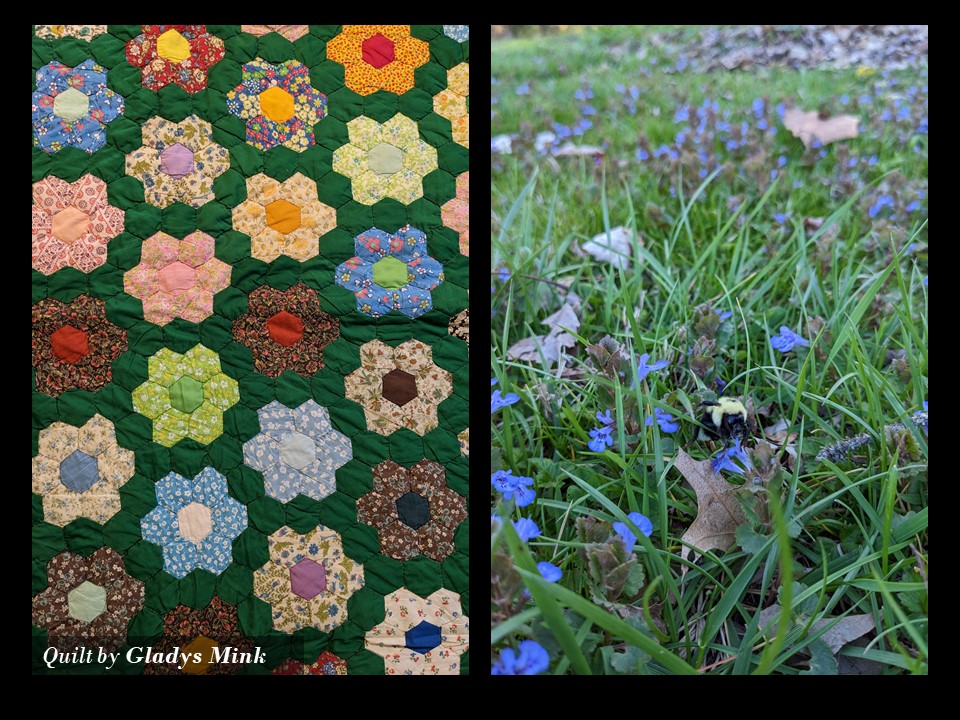
My proposal for escaping the Great American Lawn Boondoggle is The Quilt Lawn: A biodiverse, never sprayed, selectively mown, lawn where turf grass is interspersed with naturally occurring, short statured, flowering plants. The quilt lawn is similar in concept to a clover lawn, or tapestry lawn, with some important unique features. Specifically, the quilt lawn relies on a cool season grass “background” that is interspersed with patches of bright flowers from, naturally occurring, very short, flowering plants. The grass background will already be present in virtually all yards. This is the grass that has been established by the lawn service or homeowner and will include grasses that create a turf such as fescue and bluegrass. These grasses are important, especially in fall, winter, and early spring when the flowering plants are still dormant. There is no need to kill these grasses to create a quilt lawn, and there is no need to give up the basic function and visual appeal of your lawn! It can look neat and tidy. The overall approach is summarized in this Dayton Pecha Kucha talk and in this video:
How do you create a Quilt Lawn?
Step one: Free your mind! The American Lawn Boondoggle relies on a beauty standard that is based on English aristocratic values from the 1800s. The first step toward a quilt lawn approach is to “let yourself off the hook” for maintaining this highly un-natural, manicured, monoculture. If you can free your mind, and begin to think of maintenance of your “little slice of heaven” as an act of sustainability and caring, rather than chasing a “perfect look,” you are ready to create a quilt lawn.
Step two: You can do more for the environment simply by doing less. Stop spraying: Stop spraying insecticide. Stop spraying fertilizer. Call up the “lawn care” company and cancel your annual “treatment.” Pest control applications are quite expensive, and simply by refraining from application of these chemicals, homeowners can save hundreds of dollars a year and have a positive effect on the environment.
Step three: Mow less often. Again, you can do more for the environment simply by doing less. Scientific evidence indicates that less frequent mowing is better for biodiversity. Mowing once every three weeks can significantly increase lawn biodiversity. This can save the homeowner money, on average around $100 for each mowing event. If the homeowner mows their own lawn, intentionally reducing mowing frequently can give that individual a lot of extra time. Also, if possible, the homeowner can consider switching from a gasoline mower to an electric mower, which is better for the environment. The Quilt Lawn is meant to be a lawn, so it requires mowing; however, once you stop spraying fertilizer an allow the lawn to become more diverse, you will need to mow less often. The average homeowner spends nearly 400 hoursmowing over the course of their life, and a Quilt Lawn approach will give you some of that time back.
Step four: Spontaneous biodiversity. In the American Midwest, once a homeowner stops spraying poisons, the biodiversity of their lawn will naturally increase. The poisons that are applied to conventional lawns are specifically designed to kill all plants except European turf grass. Many plants live in the Midwest that will volunteer to inhabit a lawn that is being mowed regularly. These include flowering plants like clovers (Trifolium), mints (e.g., Prunella), wild strawberry (Fragaria), sorrel (Oxalis) and, of course, dandelions (Taraxacum; dandelions are good for the environment and are a highly nutritious food!). As these species begin to appear in your lawn it will get more diverse, and like all ecosystems, as your lawn gets more diverse, it will become more resistant to stressors. These plants will flower at different times in different colors providing opportunities for pollinators, and making your quilt lawn increasingly beautiful.
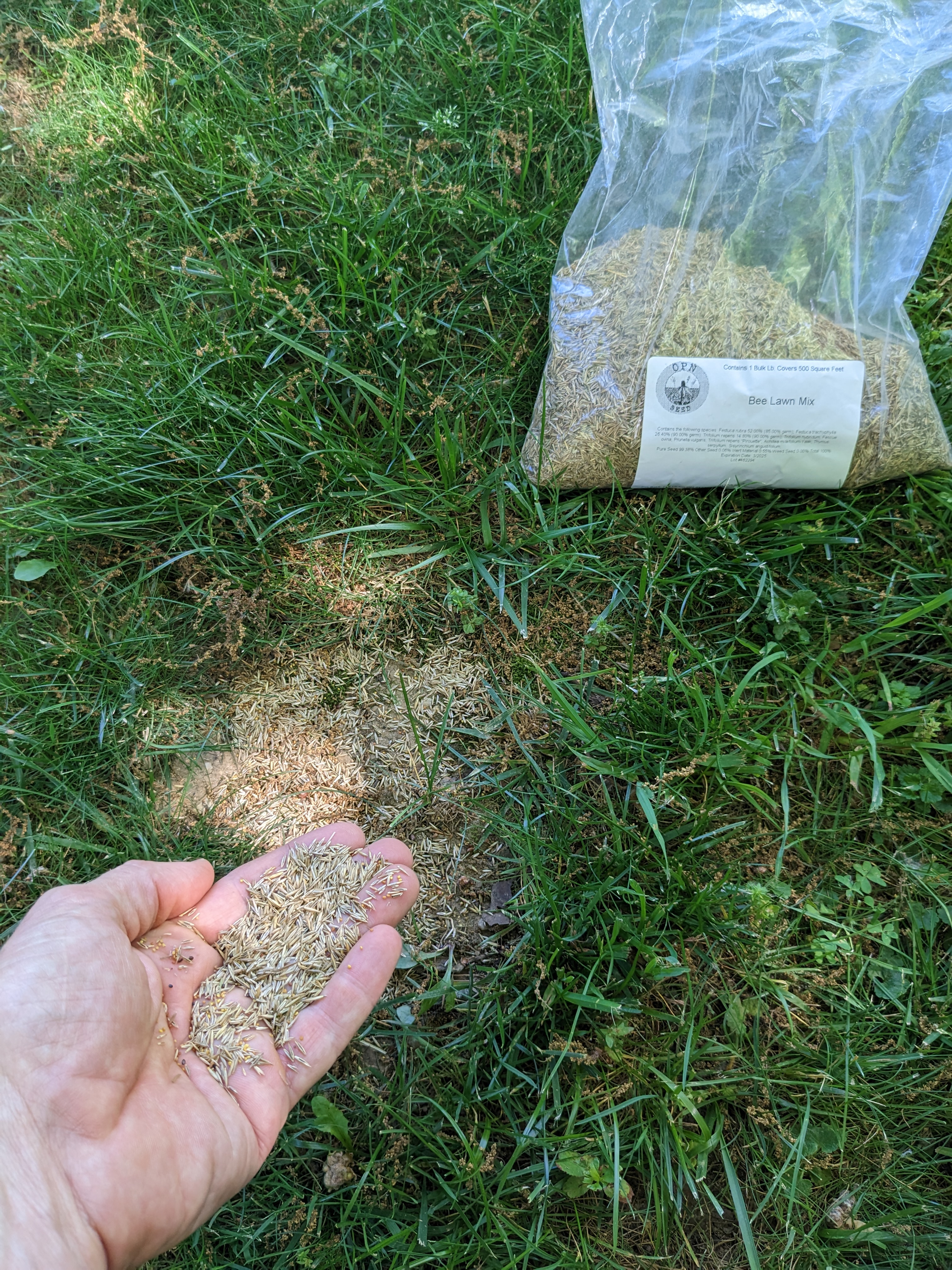
Step five: Enjoy! Creating a quilt lawn should be an enjoyable experience. If you feel uncomfortable about how your neighbors might react, you can only pursue the quilt lawn idea in the rear of your home. If you get excited and want to go further you can over-seed your current lawn with a diverse seed mix. For example, in the cool spring weather you can add seeds, such as the bee lawn mix from Ohio Prairie Nursery, to any bare patches that form.
One exciting thing about a quilt lawn is that you can welcome nature into your lawn, while still maintaining much of the basic look and function of a conventional lawn. It should be mown as needed to maintain the height and look you find appealing. A quilt lawn can be a place where you play cornhole or your kids can kick a soccer ball. Ultimately, by transitioning from a turf grass monoculture to a quilt lawn, you can save money, save time, have fun, while having a significant positive effect on the environment.
Bring your Green!
If you are excited about Quilt Lawns and ready to get started, you can get points in the Dayton Regional Green Bring your Green Challenge! Learn more about sustainability and join the community here: LINK
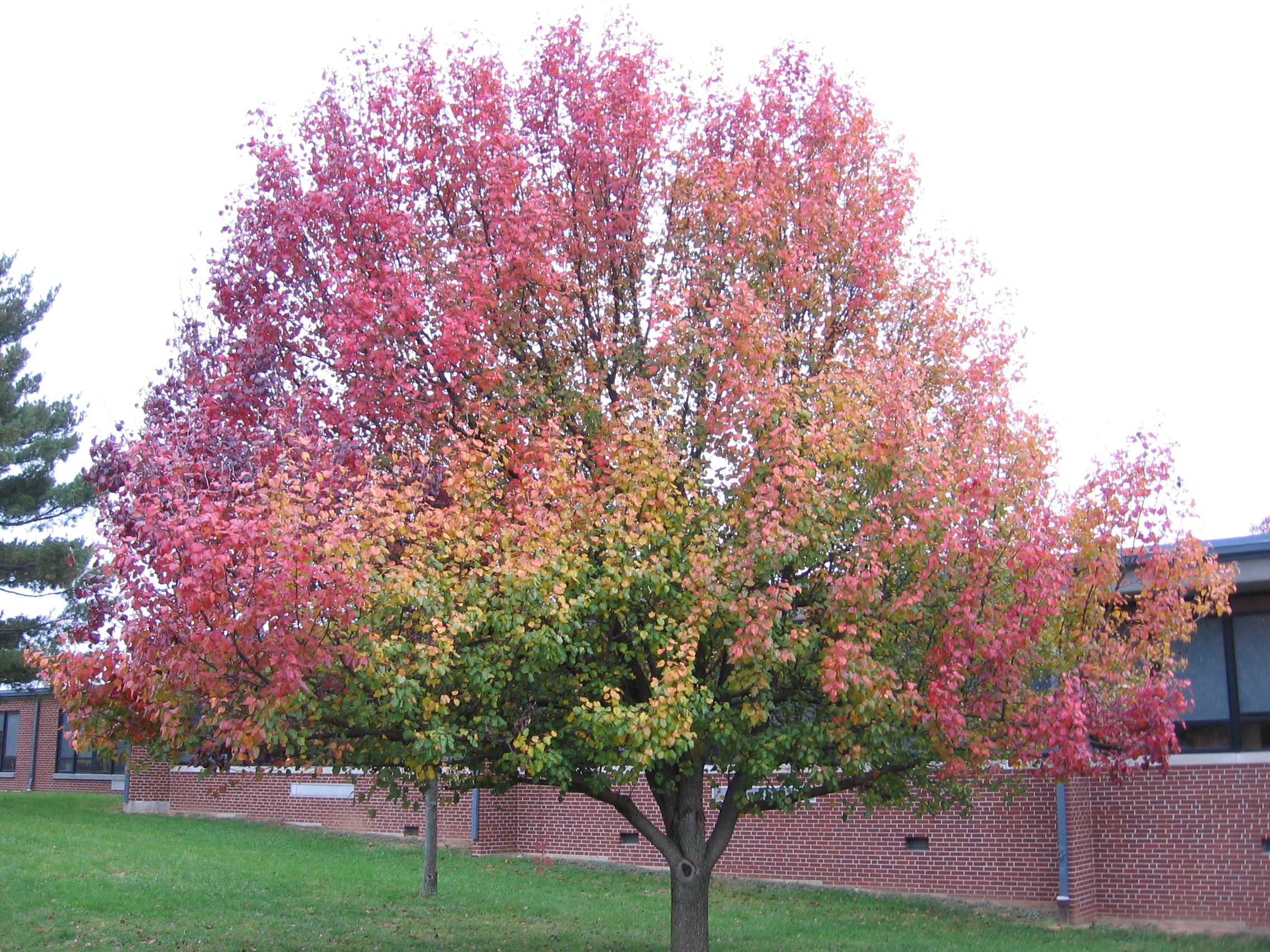
Callery pear (Pyrus calleryana) was an extremely popular ornamental tree in the United States that was planted in many neighborhoods. It has since become a highly problematic invasive tree and is presently banned from sale in some states. The story of this transformation is outlined in this article in The Conversation:
Understanding the ecology of Callery pear invasion has been a goal in the McEwan Lab for the past several years. In the lab we are exploring (a) the profile of traits that enable this species to become invasive, (b) the characteristics of ecosystems that make them more (or less) susceptible to invasion, and (c) the effects this species has on ecosystems . We are increasingly studying methods to control Callery pear invasion and restore ecosystems that have been invaded.
Here are some things we have discovered in our research so far:
___________________
Callery pear has an extended leaf duration and is frost resistant
__________________
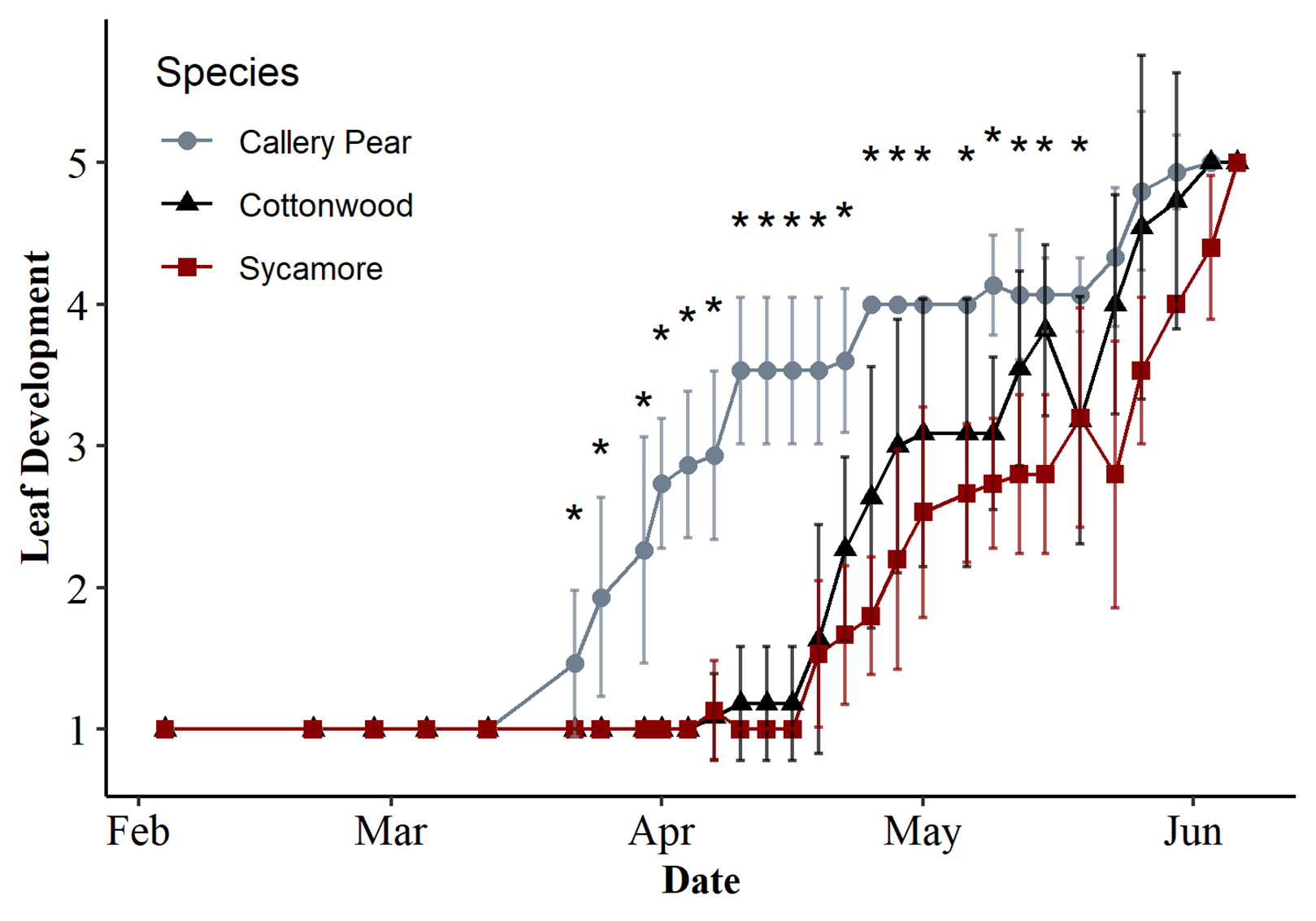
In temperate regions, like Ohio, most woody plants drop their leaves in the fall and go into a semi-dormancy stage in the winter before sprouting leaves again in the spring. The length of time during the year when the leaves are active is important for the plant from the perspective of gaining energy. We noticed that Callery pear seemed to have a longer leaf duration than many native trees and wanted to examine this more closely. In this study, we monitored Callery pear and two co-occurring native trees in grasslands near Dayton, OH. We found that Callery pear had a much earlier leaf out in the spring than either cottonwood (Populus deltoides) or sycamore (Platanus americana).
In the graph above, the grey points with the stars are above the other colored points from mid-March through late May–> This indicates more advanced leaf development for Callery pear than the other plants in the study during this time period. There was a hard frost event during our study and we found that Callery pear suffered virtually no damage while both native species lost nearly all their leaves. We found that Callery pear also held its leaves nearly a month longer in fall. The increased opportunity for growth could be an important component of the invasion biology of Callery pear.
You can read the entire open access paper at this LINK.
Here is the citation for this work:
Maloney, M.E., A. Hay, E.B. Borth and R.W. McEwan. 2022. Leaf phenology and freeze tolerance of the invasive tree Pyrus calleryana (Roseaceae) and potential native competitors. Journal of the Torrey Botanical Society 149: 273-279. Open Access: https://doi.org/10.3159/TORREY-D-22-00008.1
______________________
Callery pear invasion into grasslands is facilitated by adjacent forest
______________________
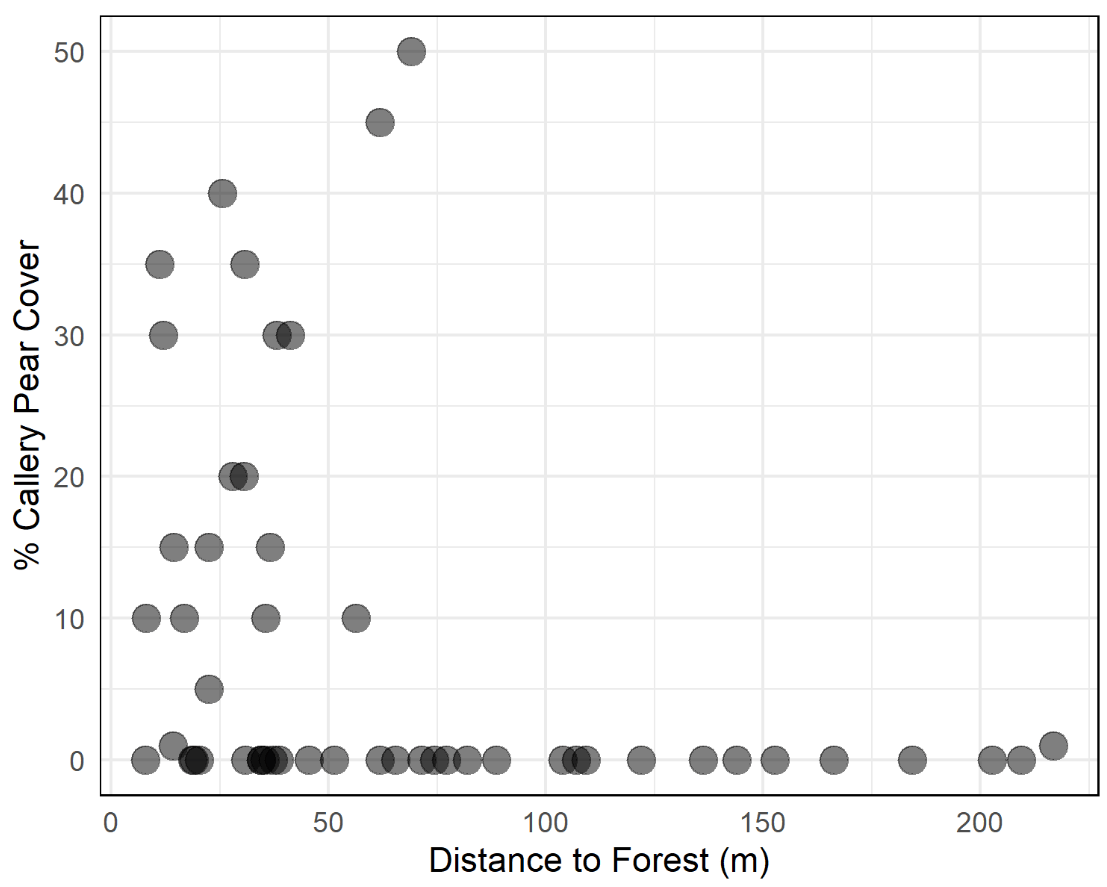
Ecological invasion into grasslands is a process that may be influenced by landscape features. The invasive plant must disperse into the habitat, and for Callery pear that dispersal mechanism is generally though to be through animal dispersal by birds. We were interested in how landscape features might influence the invasion process for Callery Pear. We sampled restored grassland sites with varying levels of invasion of Callery pear and measured the distance from each plot to various landscape features. The most important factor that we discovered in dictating initial invasion of Callery pear was distant to a forest edge.
In the graph above, each of the dots is a plot, how high the points are indicates the level of Callery pear cover in the plot and how far to the right each point is indicates how far away that plot was from a forest edge. We saw that after approximately 75 meters from the forest edge there were not plots containing Callery pear. This indicates an “edge – to – interior” pattern of the invasion process. This may be related to bird roosting sites in the forest edge. Hypothetically, the birds eat the Callery pear fruits then land at the edge of the field in trees and deposit the fruits while roosting. A lot more work is needed to verify this pattern and assess the mechanism(s) responsible. If you have observations of animals eating Callery pear fruits, please share them with us at this link.
You can read the dissertation chapter from which this article was created here (Chapter 2): LINK
The citation for this work is here:
Woods, M.J., G. Dietsch and R.W. McEwan. 2022. Callery pear invasion in prairie restorations is predicted by proximity to forest edge, not species richness. Biological Invasions 24: 3555–3564. LINK.
______________________
Callery pear suppresses seed germination of some native grassland species
____________________
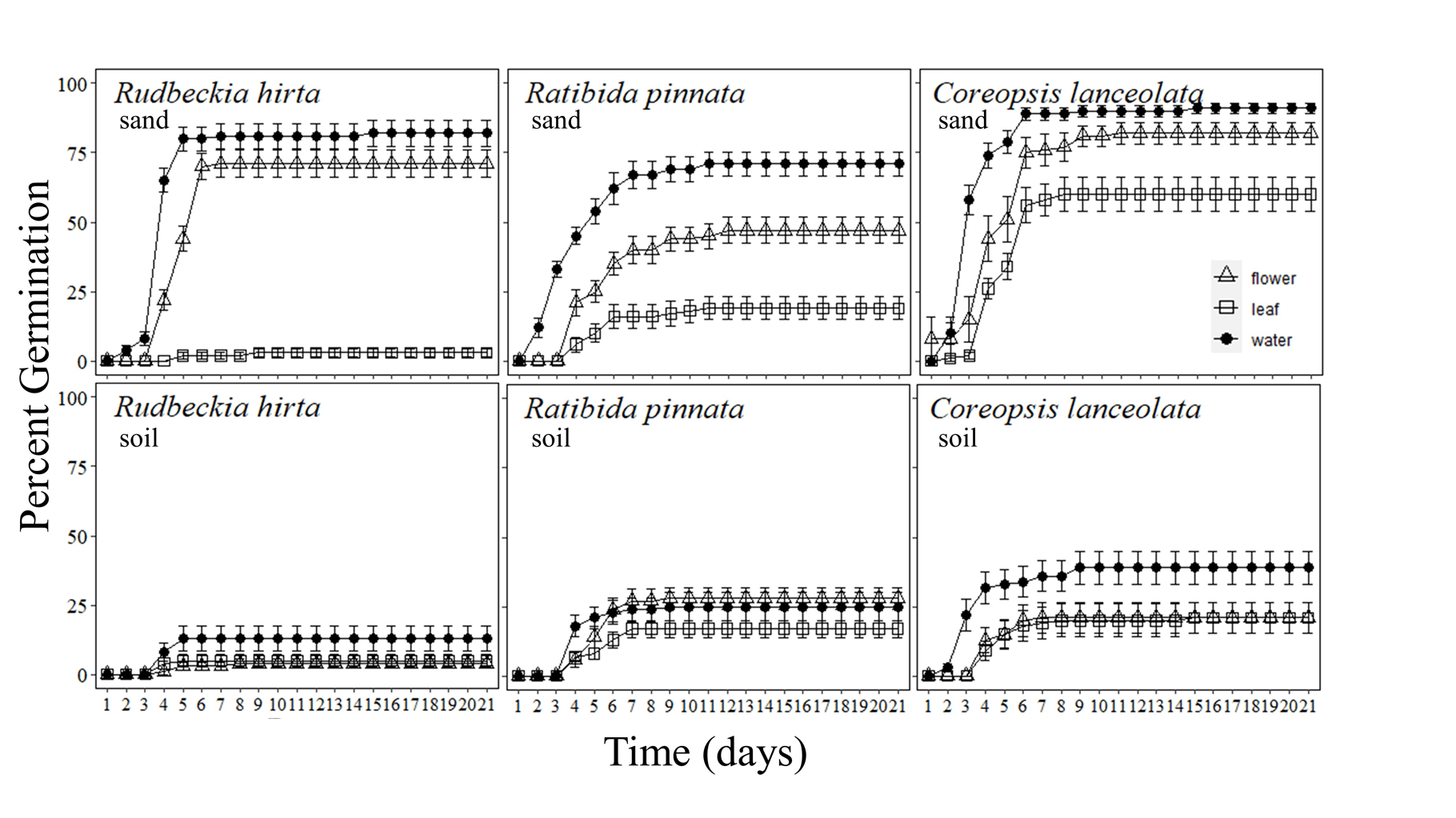
In central Ohio were our lab is located, we have noted many dense stands of Callery pear in open fields. We were curious as to how those trees established dominance so quickly. One way many invasive species, including Amur honeysuckle, are able to establish dominance is through suppression of potential competitors through chemical inhibition of seed germination. To test this idea, we conducted a series of laboratory assays in which we applied leaf exudates to native grass and forb seeds and monitored germination. We found strong evidence of allelopathic inhibition of native seeds when exposed to P. calleryana exudates.
In the graph above, look for the black circles and compare those to the open squares- where you see the black circles above the squares that is a point in time when the germination of the native plant is being inhibited by the exudates from leaves of Callery pear. We did this kind of experiment with grasses and with forbs and saw compelling results that suggest that Callery pear may be limiting competition by suppressing germination of potential competitors. Further work is need to verify this effect in field conditions and isolate the responsible compounds.
You can read the entire open access paper at this Link.
Here is the citation for this work:
Woods, M.J., D. Schaeffer, J.T Bauer and R.W. McEwan. 2023. Pyrus calleryana exudates reduce germination of native grassland species, suggesting the potential for allelopathic effects during ecological invasion. PeerJ 11:e15189. Open Access:https://doi.org/10.7717/peerj.15189
______________________
Callery pear invasion influences soil biology
______________________
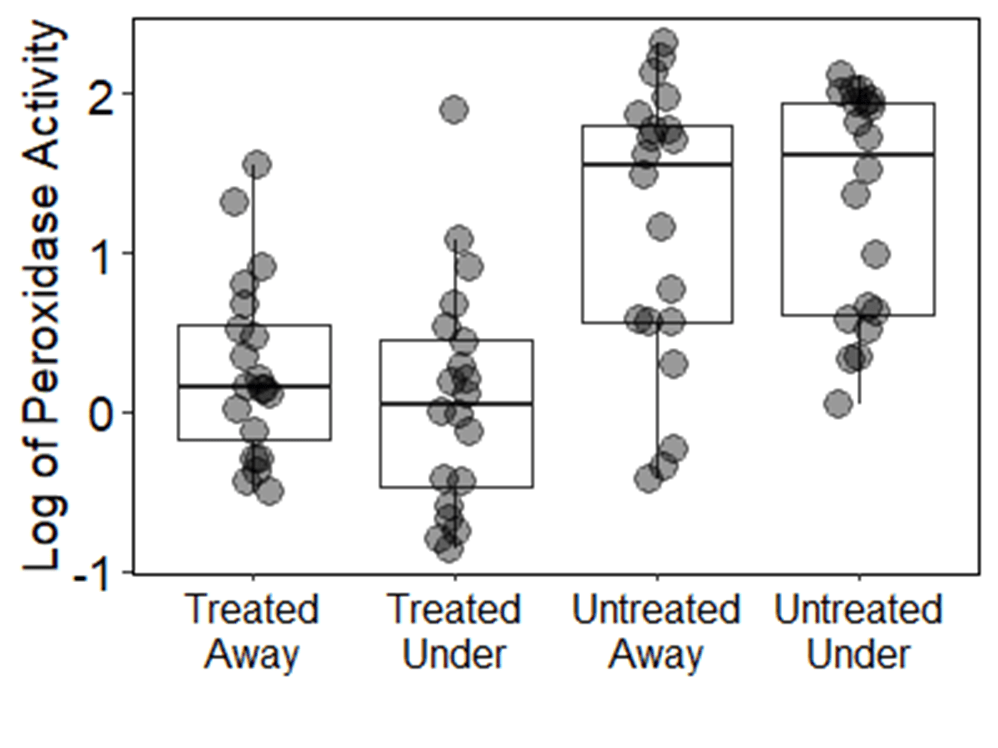
Invasive plants have strong potential to alter ecosystem function in areas where they invade. These effects can include altering soil nutrients and microbial activity. We were interested in testing for potential effects of Callery pear on soil nutrients and microbial activity. We used soil enzyme activity as a way to measure the soil microbial community. We analyzed soil under and away from Callery pear stems in two conditions: (a) “treated” stems, which had been previously cut by land managers as part of control efforts and (b) “untreated” stems that had never been cut. We found strong evidence that cutting the stems activates biological changes in the root system that alters soil chemistry. We analyzed soil enzyme activity as a way to assess overall soil microbial ecology and found significant differences among treated and untreated stems. Future studies aimed at understanding how invasion & control activities alter soil ecology are needed.
You can read the dissertation chapter from which this article was created here (Chapter 3): LINK
Here is the citation for this work:
Woods, M.J., G.K. Attea and R.W. McEwan. 2021. Resprouting of the woody plant Pyrus calleryana influences soil ecology during invasion of grasslands in the American Midwest. Applied Soil Ecology 166: 103989. LINK.
____________________
Callery pear sprouts aggressively and can survive both fire and ice!
____________________
In a series of field experiments we clipped Callery pear stems in the field then applied treatments to control sprouting.
We applied fire to small plots containing Callery pear stumps:
#########
We also applied liquid nitrogen to Callery pear stumps to freeze the stumps:
We applied these treatments to both stems that had been repeatedly mown before the start of the experiment (we called this “trees-sprouting”), and also to trees that had never been cut (we called this “trees-intact”).
Above you can see a graph from the paper, from the trees-sprouting part of the study. The height of the line in the middle of the boxes represent the number of sprouts that came back after the Callery pears where cut and then treated with one of the treatments. “Cut” are stems that were only cut and not treated. “Fire” were cut first and then burned with prescribed fire. “Freeze” were cut first and then frozen with liquid nitrogen. “Herb” were cut and sprayed with herbicide. “Neg” is a “negative control”- those stems were not cut at all. The point of the graph is that only herbicide actually reduced the number of stems (box below the dotted line). The number of sprouts actually increased in all the other treatments. What is really interesting in this graph is that the number of sprouts from Callery pear stumps that were burned (red box) is actually increased relative to the negative control (white box), suggesting that fire increased the number of sprouts! Fire is a common practice in maintaining grasslands in the American Midwest, so this result is very concerning.
You can read the entire open access paper at this LINK.
Here is the citation for this work:
Maloney, M.E., E.B. Borth, G. Dietch, M.C. Lloyd and R.W. McEwan. 2023. A trial of fire and ice: assessment of control techniques for Pyrus calleryana stems during grassland restoration in southwestern Ohio, USA. Ecological Restoration 41: 25-33. Open Access: https://muse.jhu.edu/pub/19/article/883911
___________________
A way out of the pear predicament?
____________________
Callery pear has a profile of advantageous traits including early phenology, allelopathy, and aggressive sprout response that make it an extremely effective invader. This species is influencing grassland ecosystems in the Midwest and “natural” control measures are ineffective. Herbicides are required to manage this plant; however, once you apply herbicide, the site is likely to be re-invaded. Ongoing work in the lab focuses on how to advance native species success in the presence of this invasive tree – we are currently running experiments to see if we can “hold the niche” against re-invasion.
____________________
McEwan Lab Publications focused on the biology of Callery Pear invasion:
____________________
Woods, M.J., D. Schaeffer, J.T Bauer and R.W. McEwan. 2023. Pyrus calleryana exudates reduce germination of native grassland species, suggesting the potential for allelopathic effects during ecological invasion. PeerJ 11:e15189. Open Access:https://doi.org/10.7717/peerj.15189
Maloney, M.E., E.B. Borth, G. Dietch, M.C. Lloyd and R.W. McEwan. 2023. A trial of fire and ice: assessment of control techniques for Pyrus calleryana stems during grassland restoration in southwestern Ohio, USA. Ecological Restoration 41: 25-33. Open Access: https://muse.jhu.edu/pub/19/article/883911
Maloney, M.E., A. Hay, E.B. Borth and R.W. McEwan. 2022. Leaf phenology and freeze tolerance of the invasive tree Pyrus calleryana (Roseaceae) and potential native competitors. Journal of the Torrey Botanical Society 149: 273-279. Open Access: https://doi.org/10.3159/TORREY-D-22-00008.1
Woods, M.J., G. Dietsch and R.W. McEwan. 2022. Callery pear invasion in prairie restorations is predicted by proximity to forest edge, not species richness. Biological Invasions 24: 3555–3564. LINK.
Woods, M.J., G.K. Attea and R.W. McEwan. 2021. Resprouting of the woody plant Pyrus calleryana influences soil ecology during invasion of grasslands in the American Midwest. Applied Soil Ecology 166: 103989. LINK.
Giving a presentation in front of a group of people is a normal part of professional life. These presentations are nearly always accompanied by slides projected on to a screen. As you grow as a professional, you want to make sure that you don’t have a computer glitch meltdown right before your talk is supposed to start. “Uhhh sorry, the computer is not working” is not something you want to be saying. Strategizing against these fails is a part of professional development and is a basic expectation of graduate students.
Here are some ideas on how to avoid this unfortunate situation.
Work from correct assumptions:
1. You cannot assume that the projector/podium computer will have a cable to connect to your own laptop. “Every podium has an HDMI cable right?” – -> WRONG! You must plan for the eventuality that you will need to transfer the talk from your computer onto the podium computer.
2. You cannot assume you will have access to a reliable network (eg, wifi). You probably will, but it is not guaranteed. This also means that you cannot rely on “emailing yourself the file” or pulling it off of a your drive over a network. There might not be a network, or you might have one that is unreliable, and start to meltdown if you try to pull your presentation file onto the podium computer.
3. You must assume that the projector/podium computer is running Windows, and potentially an older version.
Tips for resiliency against computer freakout:
1. Develop your talk on Powerpoint, or at least download it into Powerpoint after it is developed (for eg, on Google Slides). Powerpoint is still the standard platform for presentations and does not require a network, or Chrome, to run properly. Google slides might look great on Chrome, but it might freak out on other platforms and **the computer at the podium might not have Chrome** but, it almost certainly has powerpoint! Do you want to be standing in front of a crowd of people trying to download and install Chrome, when the wifi is sketch? No. You don’t.
2. Make your Powerpoint file as simple as possible. I personally do not use animations (you can use “insert duplicate slides” to accomplish much the same thing and it’s a lot more stable), and I do not embed videos. I also try to use “snips” instead of importing images in some cases to try and make the file size smaller. If you really want videos and snazzy animations, you really need to focus on the following tips to make sure it is going to actually work on the computer you have to present from! Its really a bummer to have someone start the talk, click on an animation, and the system freaks out and goes “blue screen of death.” If you want to have videos embedded…then make absolutely sure you have an HDMI cable and bring your own machine.
3. Download the talk to the computer and run it from there. Your are almost certain to have a glitchy meltdown if you try to just open your talk from your email and run it without downloading, especially given that your wifi connection should be viewed as unstable! Download to the desktop of the podium computer (or your own), then opent it and give the talk from there. This is much more stable than if you run the talk from a network (eg, via Google Slides), or a flash drive.
4. Work with your host ahead of time to have the talk already loaded. Go to the podium room 20-30 minutes ahead of time and set things up. Or, if that is not possible, send the talk to the host using a drive link or otherwise transfer it. Ask them to please download it onto the computer desktop prior to the talk. If the talk is waiting there on the desktop of the computer you are presenting from, then you are much safer.
5. Always have your talk on a “flash drive.” Although old technology, flash drives are extremely reliable. I actually bring my talk on 2 flash drives every time I give an invited talk, even if I have a good idea that I can use my laptop or access a network.
6. Consider a PDF format. In Powerpoint or Google slides you can save (or print) your slides to PDF and then run the presentation from an Adobe platform using “full screen mode.” If you are really worried about connectivity and computer speed, this is a good option. For example, if you are giving the talk in a field station, a PDF format could be a great option. The PDF version eliminates all slide formatting issues, creates a much smaller file, and practically all computers have at least Adobe reader.








 The McEwan Laboratory