Are you a Giving Tree Academic?

A friend of mine who has an amazing analytical mind and was a Dean at a relatively well known college once told me that “all of my best faculty are doing way too much.”  He regularly gave advice to faculty to take on fewer responsibilities.  In his experience, for the best faculty, taking on fewer responsibilities often increased effectiveness and, paradoxically, enhanced overall impact.

This perspective is quite rare in administrators, but matches well what I have found to be the truth of academic life-  most of us are fully employed–  meaning we already have full-time work to do.   This means when we agree to do new things they are additions to an already full workload.  Unless there are concomitant subtractions, we will be increasingly overworked.  Beyond being assigned work, faculty often volunteer for projects in scholarship, teaching and service that continually extend their obligations, eventually leaving them ineffective, stressed, and thin, sort of stretched, like butter scraped over too much bread.

I see the phenomenon of piling loads on top of already full schedules with graduate students, and (bizarrely) with undergraduate students as well. Graduate students who are already overwhelmed by huge science projects taking on some organizing task at the university.  Undergraduate students who dive into a suite of service opportunities beyond classwork and research, eventually driving themselves beyond the brink of exhaustion.  Academics at all levels seem highly prone to drastically overburdening ourselves.

Some academics end up being a Giving Tree. Not being able to say no, even to those who we are fond of, will likely lead, innocently enough to: onlyastumpremains
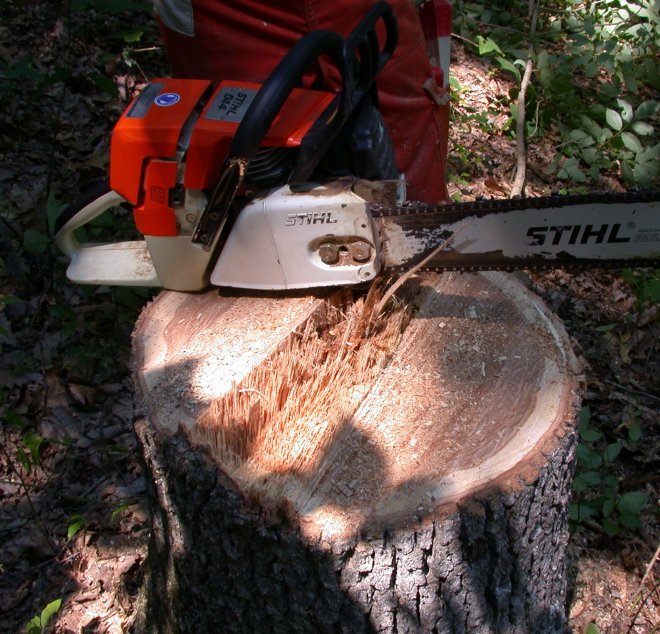
Learning when and how to say “no” is not a simple thing.

For an academic, effectiveness and activity tend to attract work, and doing well means being asked to do more. Note here that it is critical to differentiate when you are being “asked” to do something from being required to do it.  There are times when you need to find this out, ask specifically if needed!

Leaving aside assignments, and focusing on things where you have a choice: In many cases, the people who are asking you to be involved are admirable people, maybe even friends.  If you are not going to end up a tree stump, you will have to disappoint some of these people, sometimes.

You will have to occasionally say “no” to things that are DEFINITELY worth doing.

You will have to say “no” to things that you, personally, are disappointed in not doing.

You will have to say “no” to things that have potential for impact.

Most of us are terrible at saying “no”, but I do have a friend who is a successful academic and also NOT a Giving Tree.  He is very successful in the classroom, in service, and in research but has managed to keep himself reasonably buoyant and sane.  Here are three things that I know about this person.  These can be taken as action items if you or someone you know is a Giving Tree Academic:

(1) Workload neutrality.  As you consider whether to take on new things, hold yourself accountable to maintaining a stable, total, work load.  What this means is that if you take on new things, others of equal work load must be removed.  Thinking about things along these lines is helpful when someone asks (as opposed to requiring) you to join a committee, or take on a new advising task, for instance.  Will you review this paper?  How about joining the editorial board?  Help organize a conference?  Answers to questions of this sort need to start with asking yourself if in the last 6 months or so you had so much time on your hands that you could have added the task to your schedule to simply fill up the excess time you had available.   If the honest answer is “I didn’t have any extra time and, actually, have been a Red Queen- running like a maniac just to stay in the same place!”  Then you don’t have slack in your work life and simply must either (a) say NO, or (b) subtract other things from your work life to make space.  That is workload neutrality.

(2) Think “Leverage.”  What, precisely, do you want to happen next?  This is a good thing to keep in mind when deciding what tasks to take on.   It might be worthwhile to think of an imaginary scale of 1-10 where doing a 10 task directly contributes to your mission and a 1 is a complete distraction.  If your goal is scientific productivity, for instance, working on a grant would often score a 10 on leverage, whereas joining a committee on campus safety would be a 1.  When someone asks you to do something-  joining a reading group, or help develop a new assessment tool for advising- try to figure out where such an activity lines up on your leverage scale.  Is this high leverage or low leverage?  If low leverage, do you have plenty of time for existing high leverage items?  If not, you must say no!

(3) Outside life.  My friend has made it a point to indulge in a healthy off-campus hobby that makes him happy and is fun.  Many academics end up in a situation where their work life is their whole life.  While that might be good for some people, in others it leads to a Giving Tree mentality.  If there are no guardrails on your work life, it may expand to fill up all the space available…meaning it could come to dominate you.  If that works for you, fine!  But if you are manifestly unhappy, then you will have to build a fence around your work life and do some things on the outside of that fence that you enjoy.

One closing thought that might be a helpful thing for you to embrace, a thought to center on if you feel that you have become a Giving Tree:

It is unacceptable for daily work life to manifest as trying to keep your head above water in a torrent of obligation.”

It does not matter that this seems to be “just the way things are” or that you see others similarly drowning. It is wrong for them, and it is wrong for you and it does not have to be this way.

It is not healthy or sane to live this way.

If you live this way, you will do things poorly that you could do well.

The rational move is to continue to jettison things, and say no, until your life is no longer a torrent, and you are in control.

The Giving Tree is not a sustainable model, and you need sustainability in your work life.  Furthermore, we all need you to stay in science, and be whole, and help move us forward!

-rwm


Climate Change Conversations

Welcome!

Recently I decided it was pertinent to broaden my engagement in science communication.  It is critically important that those of us scientists who are positioned to do so, extend ourselves to reach out to the public and address basic issues.

Along these lines, I want to start conversations about climate change science and do my best to address questions that arise.

I want to start by addressing a few claims that I sometimes read in the media:

False Claim 1

There are places in the world that are getting cooler through time, which disproves the whole idea of Climate Change!

Sometimes I have heard the argument that Global Warming as a phenomena means that EVERY PLACE on the globe will get warmer through time in relationship to EVERY historical time point.

If there are local areas that are not getting warmer, or are cooler in relation to specific time points in the past.

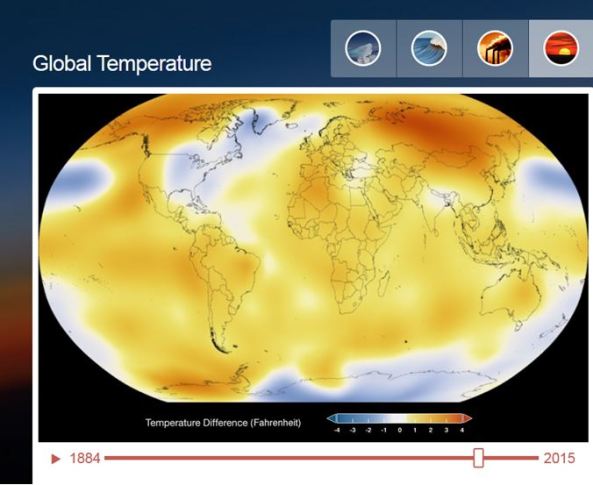
As a specific example, the map below shows how the temperature has changed across the globe from the beginning of instrumented records (1880) to the present.  That means, from the time that we have records of temperature.  The map extrapolates from the different points in space.  Red colors means warmer, blue means cooler.  The image below is a snapshot that compares 1997 to the long term average and you can see that eastern North America is actually cooler that year (blue colors in the map below mean cooler temperatures- from NASA:  Link.)

1997

One could then conclude, if they only used data from New York for instance, that in the year 1997 it was actually cooler than the long-term average.  This would be accurate in fact!

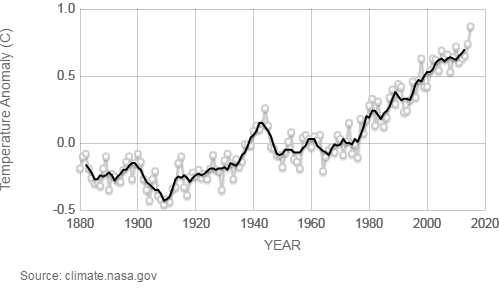
However, this particular point in space does not overwhelm the overall global pattern.  If you look at that map at Siberia, you would say it is massively warmer through time, and if you average across the GLOBE you would say it is getting warmer. Focusing on one space and one point in time ignores the term “Global” in Global Warming.   In fact, if you look at global temperature, the long term warming trend is easy to see (from NASA):

globaltemp

False Claim 2

Scientists are making money on Climate Change and are funded to be part of a conspiracy, which is why their data consistently supports Climate Change as real.

Climate change deniers act in bad faith when they accuse scientists of generating data to make money.  They sometimes claim or insinuate that the reason a scientist would publish data that supports climate change is that some hidden agency or company is actually giving them money to do so.  Everyone is motivated by money!  Right?

Fine, but in this case it has little to do with the way climate science is done.

The fact is- scientists who do climate change research practically never have financial gain as a part of their project and often end up paying money to publish their Climate Change research (in the form of what are called “page charges”)!

I can speak to this from firsthand experience because I have personally published climate change research.  Here is my article in what is called pre-print form: Link.  And the Link to the article on the publisher’s page.

I can tell you with absolute certainty that:

-No agency, including the University of Dayton, provided any compensation at all particularly for the publishing of this manuscript. In fact, if I remember correctly, I had to spend money from my account to cover the page charges.

-The publication of this manuscript had very little, if any, real influence on my career.  Meaning that I did not NEED to publish this article and that writing a climate change article was neither required nor particularly significant in my career. It was enjoyable, and I think the findings are important and interesting, but I didn’t NEED to publish this.  I have never used this article in a grant application.  It is listed with my other publications on my resume, but whether it is there, or not, matters very little to my career.

-The climate data were acquired from a publicly available source.  Anyone can find those data and run the analyses on the climate variables from our study.

-The results of the study do not necessarily follow some kind of orthodoxy (more on this below).  If you read the paper, it does not claim that all species are being influenced by Climate Change.  Some are, some are not.  It depends.  Further, it depends on which particular climate metric you are looking at!  So there was no “purity test” for this publication.

In summary, I am a climate change researcher, as evidenced by this publication, and I can assure you there was no secret compensation.  I am offended, honestly, by the very idea of it.  I know plenty of people who do climate science and they are like me.  Just asking and answering questions and following the data.  We are paid by Universities to teach classes and mentor students.  We do win grants sometimes, which is awesome, but we spend the grant money on things like salaries for undergraduates and equipment for our projects.   We financially benefit from grants sometimes in the form of “summer salary” which is money to cover months in the summer where we are not employed by our home institution.  Many academics have 9 month contracts that run from August to May, so we can supplement our income in the summer through having the grant cover those months.  If we do not have money to cover that time, any research time we spend in the summer is volunteering!  Summer salary is the only form of financial compensation that we may get from winning a grant, and that is relatively rare.  The money associated with our projects generally just fuels more research.  Also, as a side note, we are super careful with this money!  I imagine that federally funded research grants are the most carefully accounted for dollars anywhere in the federal budget.

It is worth pointing out that scientists who had a heavy incentive to prove Climate Change was false ended up coming to the conclusion that it is in fact real, in spite of their interests.  In fact, according to this story in Scientific American which was followed up by Rolling Stone (here), it has become increasingly clear that oil companies own internal research supported Climate Change as a real phenomenon linked to combustion of fossil fuels by the late 1970s.  In fact, it looks like their models were quite good as their estimates of temperature change and timelines seem to match current models.

False Claim 3

Scientific orthodoxy demands that we generate results that support the Climate Change paradigm and doing otherwise, even with good evidence, would ruin our careers.

This is a common sense argument that appeals to the skeptical public- basically, that scientists would be encouraged toward herding behavior based on self interest.  If you do not “toe the line”, your career could be negatively impacted, which would force scientists, even if they have counter evidence, to support climate change.  The problem here is that it is a complete misunderstanding of how science actually works.  In fact, science is an inherently confrontational system that rewards “transformational” research.  Indeed, the most funding, and highest profile, goes to science that changes the way we view things.  A discovery that changes paradigms is much more important than one which reinforces things that we already knew.  So, actually, a scientifically based refutation of climate change that could withstand peer-review and is rigorous would be an incredible boon for any scientists career!  It could possibly lead to a Nobel Prize in fact.  IF(!!) the science was sound and ended up being true it would upend an incredible body of research and utterly transform how we understand global systems.

Despite the incentive, it is extremely unlikely that this will come to pass because an incredible body of research exists supporting Climate Change.  It has been tested and re-tested, and the indications always end up pointing in the same direction->  the Earth is getting warming and human-caused emissions are an important driver of this warming.

Good Sources of Information

There are many great sources of climate information.  Below are three that are excellent and I would recommend to anyone who is looking to communicate with a climate skeptic:

(a) NASA–  Who else!?! Gorgeous, user friendly and data rich.

(b) IPCC– The Intergovernmental Panel on Climate Change is a highly respected global information clearinghouse.  Perhaps one of the greatest accumulations of scientific knowledge ever assembled

(c) Real Climate– Climate Science from Climate Scientists.

—-

If you have ideas, please share either in comments or directly to: ryan.mcewan@udayton.edu

-rwm


Presentation Slides


An invasion biology skeptic meets an invasion biologist: A hopeful dialogue.

Glass_of_Stout

Setting-  Back porch in Dayton, Ohio.  Belgian Stout and a beagle mix present. 

Invasion Biologist:  “Thank you so much for coming, I hope this will be a useful exchange…Shall we begin?”

Skeptic:  “Shoot!”

Invasion Biologist: “So you are telling me there is an ash tree standing right in front of the porch?”

Skeptic: “What do you mean?  I don’t see anything but grass… a seedling?”

Invasion Biologist: “No a large ash tree!  It’s 50 feet tall with a large crown?”

Skeptic:  “This is a bad way to start a dialogue – – I have no idea what you are talking about!”

Invasion Biologist:  “There was an ash tree in my yard, 50 feet tall; it stood right there in front of us.  It died because of an infestation of the Emerald Ash Borer…a well-known exotic, invasive, insect.  As an invasion biology skeptic, are you saying that tree actually didn’t die?”

Skeptic: “Come on…”

Invasion Biologist:  “Okay, so we agree that my tree was killed by this insect?  After all the larvae were present and abundant…I chopped the wood by hand once the tree was cut, I saw them!  Can we also agree that I have lost the $1,300 that I spent to have it cut down?  That money is not actually in my wallet?”

Skeptic: “…” frowning, checks his watch.

Invasion Biologist: “I could use $1,300- the AC in my car is broken, are you sure I don’t have it.”

Skeptic: “…” scowling.

Invasion Biologist:  “Okay, so we can agree that the Emerald Ash Borer killed my tree, and also virtually every member of the genus Fraxinus across a large swath of the Midwest?”

Skeptic:  “Hmm, that is a leap- A lot things can cause a tree to die.”

Invasion Biologist:  “Yes, but these mortality rates are exponentially greater than background rates, and the causal factor is well-known, empirically, to be this particular insect”

Skeptic:  “Alright, sure, these trees are killed by the borer.  Can we get on with it?”

Invasion Biologist:  “Please just go along with me for a bit here…. We agree that the tree was killed by the borer and it’s expensive?  My tree cost $1,300.  After talking to the very person who writes the checks, I know for sure that a small park district here in Dayton is spending $250,000 just on ash removal in the next year.   They did not have that money sitting around, it cuts them deep in other areas to deal with those trees, and those are only trees that might fall outside their parks onto streets or houses, not including inside the park trees which will be dealt with in future years.  Everyone living in the region, the municipalities, the people, have trees to deal with along streets or in yards and so forth, it is *extremely* costly for the region.”

Skeptic: “Fine”

Invasion Biologist:  “Okay, so this borer is well known to have arrived in the US via cargo, probably in pallets.  This is known to be a relatively discrete event, and resulted from the insect being transported across the Atlantic Ocean in an airplane.  Fraxinus where the borer normally resides do not suffer mortality to this extent, but the ash trees here in the US have no resistance, resulting in it sweeping through our populations.  The insect was accidentally moved by airplane right into the middle of a vulnerable population.  It could not have leapt over the Atlantic on its own…”

Skeptic: “No, I am not going to agree to this, what about some kind of wind storm or other event, it surely is not impossible for them to have crossed the Atlantic. The adults can fly at least some distance.”

Invasion Biologist: “Yes they fly, but the distances are infinitesimal compared to crossing the Atlantic Ocean with no stopping spots.  We know that dispersal curves have very long tails, but this is almost beyond imagination…can we call it getting here instantaneously, without human help, “exceedingly unlikely?”

Skeptic: “Okay, fine”

Invasion Biologist: “There are a great many insects and other critters that utilize ash trees for some portion of their life cycle.  I am not sure anyone has done a comprehensive survey, but would you agree that at least dozens of insects and animals is a reasonable minimal number to assume (although the number may be very much higher)?  And, can we assume that the origin of this menagerie includes species both from local environment and those that have been transported in by humans in various ways?

Skeptic: “And some of the species that have been moved to the US, and are using ash, are causing no harm, and may in fact benefit the tree!”

Invasion Biologist: “Ohh yes!”

Skeptic: “Fine, I agree.”

Invasion Biologist:  “Okay, so the way this particular insect interacts with ash trees is VERY different from those of the existing menagerie.  Radically different.  It has swept through the range of ash, killing the tree with unbelievable effectiveness.  In some areas where it first arrived the kill rates were nearly 100%.  The genus Fraxinus, which is a very important part of both urban forests and wildlands, is in big trouble in the region.”

Skeptic:  “Okay….”

Invasion Biologist:  “The spread has been rapid, and it seems, so far, wherever the insect gets a foothold, it grows explosively.  It is penetrating into whatever insect communities exist in these habitats with ease, defeats whatever defenses the ash trees have, and establishes populations that drastically reduce the ash populations.  Tens of thousands of trees are dying in here in Dayton OH as we speak…in fact, if you don’t treat your ash tree with insecticide it can safely be assumed that it will perish in the next 5 years or so.”

Skeptic:  “I am familiar with the insect… this is terribly tedious”

Invasion Biologist:  “Humor me?”

Skeptic:  “Fine….”

Invasion Biologist:  “You’re too kind, would you like another bottle?  There….now, can we agree that the biological action of this borer is relatively unique?  That the insect is acting in a way that is different from the menagerie of organisms already here when it arrived?”

Skeptic: “mmmm, not totally comfortable with that…what do you mean unique, that’s vague?”

Invasion Biologist:  “Fair enough, but we can assume Fraxinus was doing just fine living with the menagerie, but when this one insect arrived it has experienced precipitous crashes in population, so in that way this biological action seems clearly unique”

Skeptic: “Go ahead…”

Invasion Biologist:  “Can we say about the biological action of the borer that it is characterized by: rapid population growth and spatial spread and widespread detrimental impact to a long standing member of the local biological community?”

Skeptic:  “Sounds reasonable”

Invasion Biologist:  “Can we agree that this biological action is economically important (if not, can you give me $1,300?)”

Skeptic:  Yes (and no)

Invasion Biologist:  “Can we agree that this biological action is scientifically interesting?  And that studying the reasons why this particular insect acts this way, and members of the menagerie do not, could have both scientific impact and help human society?”

Skeptic:  “Sure that sounds true.”

Invasion Biologist:  “Can we agree that there are other species that seem to exhibit a similar biological action?  Some species act this ways, and others don’t, and figuring out why is a useful goal for science”

Skeptic:  “I will go along with that”

Invasion Biologist:  Can we call this scientific study “Invasion Biology”

Skeptic:   “No:  First of all, the language is jingoistic…it suggests actual hate of all species that were not here when Daniel Boone arrived here in Ohio…

Invasion Biologist:  “… Okay how about we call this area of science: Newly Arrived Organisms With Rapid Population Growth and Spatial Spread and Widespread Detrimental Impacts to Longstanding Biological Communities… biology?”

Skeptic: “Now you’re just being a jerk.”

Invasion Biologist: “Sorry, how about we use initials:  N.A.O.W.R.P.G.S.S.W.D.I.L.S.B.C Biology?  Sounds like a good name for a journal, no?”

Skeptic: “grrrrr”

Invasion Biologist:  “Well maybe we can come up with something better…but in the meantime, we agree on every key issue!”

Skeptic:  “You want to wrap up so early…why – Do you need feed your nativist fever by reading Desert Solitaire for the 14th time and staring at some Ansel Adams photos?”

Invasion Biologist: “arrgh…!”

Skeptic: “Relax man, just kidding…but look, seriously,  you have missed the whole point: Not all “exotic” species are harmful and..”

Invasion Biologist:  “…Hold on…that is a Straw Man- you know damned well that Invasion Biologists have always taken as a central tenant that very few exotic species become invasive.”

Skeptic: “Fine, but even the concept of “native” is terribly arbitrary.”  In fact, with the planet rapidly warming the whole idea of “native” is rapidly losing meaning.”

Invasion Biologist:  “Okay…its a fair point…however, would you agree that figuring out why some **tiny fraction** of exotic species become catastrophically harmful while others just nestled down into the biotic community is a useful endeavor?  After all, this work could help us predict or mitigate negative effects, and as we established already, a few invasive species (like Emerald Ash Borer) end up being economically and ecologically devastating.”

Skeptic:  “Sure, of course, but what does “exotic” even mean at this point in history where habitats are such a mess due to human activities (eutrophication, landscape structure changes, etc.) and with the climate changing very fast.  In fact, defining “native” as some date in time, such as 1750, is completely indefensible and arbitrary”

Invasion Biologists:  “Yea, we can agree that a specific year is hard to defend; however, surely you would agree that humans moving species around the globe was influenced by the internal combustion engine, industrialization, and the eventually growth of air and sea traffic such that in modern times the probability of any particular species dispersing across the oceans, and long distances over land, has been unfathomably increased.”

Skeptic:  “Sure, but that just makes the point for me- the native vs. exotic definition is a mess in modern times!”

Invasion Biologist:  “If we agree that dispersal has massively increased due to human commerce (which we did) then picking a particular date to demarcate native vs. exotic is trivial.  The point is that species are moving around the planet in a radically different way than just 200, much less 500, years ago…which is a very short time ecologically!  These terribly Anglo-centric dates such as 1492 or 1776 do not stand up to scrutiny, and deserve your skepticism; however, the Columbian Exchange detailed by Alfred Crosby is a real Biological event and radically increased global dispersal patterns, especially post WWII, in relation to human commerce DOES stand up to scrutiny and IS biologically meaningful.  Right?”

Skeptic:  “Sure, but how can you base policy or management activities on arbitrary definitions.  You have people spraying herbicide from airplanes in order to remove species that are defined as “invasive” only because they are “exotic”, but your definition of “exotic” is weak if not arbitrary.”

Invasion Biologist:  “I am worried about herbicide being sprayed from airplanes and other spillover effects of control…very worried…however, we agreed that some of those species dispersed due to commerce will cause bizarrely massive devastation, and we agreed that the existing menagerie do not cause the same kind of damage, and we agreed that figuring out which species act that way and which do not is a useful scientific pursuit and agreed on the need for Biological research on this phenomenon.  I believe it is an *urgent* task for Invasion Biology to verify harmful effects of species that we are calling “invasive” and further to discern the ramifications for non-target species and overall ecosystem function of various control options for Invasive Species.  These are URGENT problems… within the field of Invasion Biology.

Skeptic:  “Well we agree on the urgency of these issues – so why aren’t you working on these things?!”

Invasion Biologist:  “Yes we agree…and actually, as you can see, we agree on all the issues and always have underneath the semantics.  And, I AM working on verification of negative effects, and issues related to spill-over, but continue to be mighty distracted by arguing with you!  It would be a big boost if you would help me with the difficult and *urgent* tasks ahead of us.  Could we set aside the semantics and get to work on these basic biological questions?  Will you help?”

Skeptic: …(to be continued)

-rwm

Maternity, timelines and seeking a career in Academia: An overview and 10 action items

Womyn_Academic,SoSleepy

A woman in Academia* with her Little One

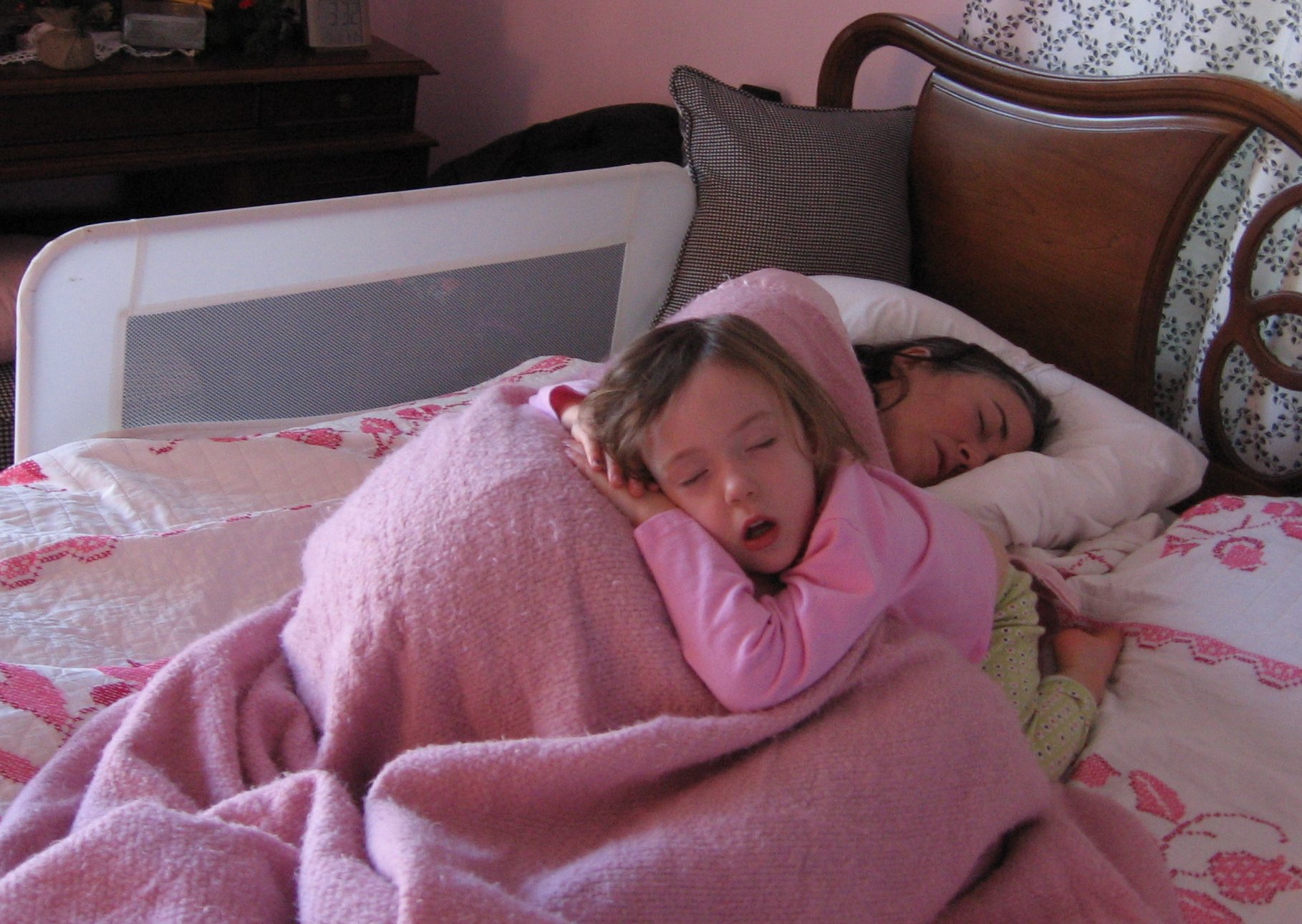
The path to a tenured faculty position, the first point in the academic career at which you can feel real stability, is arduous and fraught with potential for getting off track.  The process also takes a long time:

Process Years
Undergraduate Degree 4
Master’s Degree/ Other Experience 2
PhD 5
Postdoc 3
Pre-tenure period 6
Sum 20

If you begin as an undergraduate at age 18, then you will finish this process at approximately age 38.  Perhaps one could quibble with some of the details; however, an estimate of 20 years as the length is about average, and going significantly faster than this is unlikely.  So, this is a long and difficult process for anyone; however, it is particularly challenging if you have, or are planning to have, offspring.  When in this process is a good time to have child(ren)?  The only choices are (a) before starting the PhD, (b) during the PhD, (b) during the Postdoc, or (d) during the tenure process.

The timeline is tricky for any potential parent in academia, fundamental differences between being a partner to a woman having a child and being the woman going through gestation, birth and the postpartum experience, make this a unique challenge for a female academic.  Women experience physiological changes during the 9 months of gestation, and sometimes these prevent a full work load.  These changes are separate and apart from the time spent breastfeeding, diaper-changing, keeping them from cracking their heads on the table edges, and all the things partners can help with.  Thus, to achieve a “level playing field” for women in science means, necessarily, creating opportunity for maintaining career momentum while supporting leave time during pregnancy.

Not all parents have partners and not all single parents are female.  There are myriad potential parenting situations, including grandparents taking over primary responsibility for raising a grandchild, adoptions by both heterosexual and same-sex couples or by a lone individual. 

In any case, if you have child(ren) during the the time leading up to tenure there is a chance of reduced productivity in relationship to potential competitors without children or with mates bearing the primary biological or caretaking responsibilities.  Because only women get pregnant and, in general and historically, women have carried the majority of childcare responsibilities, there has been a systematic disadvantage for women in Academia.  A recent article from Slate outlines this very clearly.

So what is to be done?

 Action Items:

(1) Health insurance for graduate students including dependent coverage.

Many universities provide health insurance options for graduate students, and in some cases this includes coverage for dependents.  There is a lot of ongoing change in health care related to The Affordable Care Act and other socio-political forces and we don’t know all of the implications for academics having children.  Whatever the case may be with national policy, we strongly urge all universities to ensure that graduate students have health insurance, including maternity coverage and coverage for dependents.  University administrators: Stop talking about how you value diversity in hiring until you remove this kind of basic barrier for women to enter and succeed in academia.  Graduate students: it is entirely appropriate to ask about health insurance prior to joining a university graduate program!  Faculty: find out for yourself what health care options exist for graduate students and be prepared to present that information to students you are recruiting.

(2) Maternity leave for graduate students.

Graduate students should/must be given maternity time off.  We would imagine in many programs there is enough inherent flexibility that maternity time can be assimilated into the program without particular rule changes; however, some policy statement of support could and should be adopted by graduate programs.  Graduate Program Chairs and Faculty Mentors should be ready and willing to help graduate students modify their projects to accommodate leave time.

(3) On-site child care or child care stipends for graduate students.

Once maternity leave is over there are many more years in which child care is a necessity.  It is a tremendous burden to find child care that is acceptable, psychologically difficult to drop off and leave your little buddy; and, it is absurdly expensive if you are living on a graduate student stipend.  Many graduate students have traveled far from their families (many international students are, literally, oceans away) so informal support is lacking.  These barriers to professional success are unique to those who have children, and most of the time women disproportionately bear these burdens.  For this reason, one action that would help equalize the “playing field” for women in academia is institutional support for child care. This policy is also very basically “pro family.”  Support for child care could take the form of on-site subsidized child care or a stipend for off campus services.  Indeed, we recommend that if a particular university cannot provide on-campus child care, they establish relationships with off-campus operations and provide aid for students in finding quality child care. 

(4) Time-line assistance for post-docs (grant extensions, university support).*

A postdoctoral appointee is usually categorized as a full-time “staff” member and will typically have access to health insurance and leave policies that are provided to all other full-time employees.  Even so, a postdoc almost always depends on the availability of grant funds to cover the salary and fringe, and the money itself nearly always has an end date within about 3 years.  Universities and funding agencies need to recognize this reality by adopting maternity leave policies that address these timeline issues.  One straight-forward action would be for major grant funders to create timeline extension policies for grants that include a postdoctoral associate.  Indeed, NSF now requires a postdoctoral mentoring plan be included in grants that seek funding to hire such a person, so infrastructure is in place for: (a) identifying grants that include postdoctoral funding and (b) assessing the quality of mentoring.  A simple additional step is to include a maternity contingency agreement between the award winning faculty and the granting agency.  We further recommend that large granting agencies set aside special funding to help bridge project delays associated with maternity leave.  For instance, any grant that includes postdoctoral funding can promise 6 months additional salary and an automatic one year extension of the grant to cover maternity leave if needed.   

*Thanks to Natalie Wright for bringing this issue into focus for us.

(5) Maternity-related leave and tenure-clock flexibility for tenure-track faculty.

Regardless of industry or occupation, women should get time off to have a baby and be home in the early days.  So it should be a normal expectation that women in academia are offered at least one semester leave from *all* university-related activity as “maternity leave.”  In combination with a summer either prior or following that semester this constitutes a strong maternity leave period.  We further recommend that this policy be extended to include post-adoption periods for new parents.

Some (most?  all?) universities provide faculty with the opportunity to negotiate tenure timelines in response to the development of unique and potentially problematic circumstances.  For instance, if you typically come up for tenure in your 6th year and some significant event occurs, you could argue for a one year delay on the decision and instead come up in your 7th year.  We propose that this be an automatic “offer” that accompanies maternity.  An extra year, with no change in criteria, simply provides for parity in candidate bids for tenure.  Moreover, having it as a built-in policy would remove any “stigma” of having to petition for extra time.  That extra time could be declined by the candidate if pre-tenure reviews indicate success is inevitable, or taken to bolster the case for tenure.  We further recommend access to this policy for anyone involved in a new parenting situation (including adoption).

(6) University-level support for departments to cover maternity leave.

With an obligation to provide one semester leave for maternity and new parents (as proposed above), departments need institutional support to cover the missing activities.  For example, funding to hire instructors or other staff to fill in this gap should be provided.  If it is not provided, and the department is left to bear the burden of the missing faculty member, the pressure will inevitably shifts back to the parents involved because it will be strongly in the best interests of the Department to have the Faculty member decline the offered leave.  This would de facto invalidate the leave policy.

(7) Research assistant support for tenure-track women on maternity leave.

If the new parent is in a research heavy department with high expectations for publication and grant writing, the idea of leave seems absurd…because absence from the research endeavor kills momentum, endangering the program and, thus, the upcoming tenure bid.

This one is extremely hard to manage from an institutional/policy perspective as nothing the university can do can fully replace the research activity of the person on leave.  One thing that may help would be institutional support for a research assistant for the maternity leave period.  Again, that person cannot possibly replace the function of the PI; however, it may be a way to create a bridge.  For instance, it may enable the faculty member to retain a finishing PhD student in a 6 month post-doc position who could get some papers out and maintain lab momentum while that parent is snuggling and sleeping with the new little one (which she should feel free and happy to do!)

(8) On-site child care or child care stipends for faculty.

See the above argument for grad student child care.  Of course, faculty members have a much stronger financial base than graduate students for paying for child care, and yet, the basic issues remain.  It’s very expensive, time consuming, psychologically draining, and logistically complicated to land a child care scenario that works for parent and child.  Universities should seek to develop on-site options and support for faculty in finding child care outside the university if necessary.  If no child care options exist on campus, we suggest universities create a stipend program to cover child care for parents in academia that is separate from salary and a set of relationships with off-campus providers.

(9) Mentoring programs for tenure-track faculty

All faculty need tenured mentors and advocates in their program that can help them navigate the tenure process, especially in cases that involve the maternity experience.  Departments need to make sure this support is available.

– – –

**We realize these 9 action items address but a small part of the social infra-structure that has yielded a male-dominated academy.** 

Even so, we feel strongly that they are structural components to a long-term solution.  Further, these basic items are not only pro-women, they are pro-family, and, to that end, are in everyone’s interest.

One final item that we recommend (10) is that everyone involved in mentoring in academia take part in creating conversations around the issues of gender equity and balance, and parenting in the Academy.  Getting these issues on the table in front of both males and females, starting during the undergraduate experience, will help transform discourse and policy in the future.

This post was co-authored with *Amy L. Goff-Yates, PhD

-rwm

Some ideas for advancing graduate education in Ecology in a time of scarcity

The science of Ecology, like most scientific disciplines, is in the midst of a crisis of sorts stemming from at least two underlying factors. First, funding for science at a national level is stable or in decline, while the number of labs that need funding to persist is rising sharply. Second, the number of PhDs being granted is vastly outpacing the job market. According to some analyses the percentage of newly granted PhDs that got a job as a tenure-track academic in the 1970s was nearly 50%, while that number today is less than 10%.

In the face of this gloomy picture, action is required and I believe there are some clear steps we can take. In my view, lobbying for more federal money, tweaking how funds are distributed, working toward some supplements to federal funds (e.g., crowdsourceing..like this and that) are good things to fight for. Those are “supply side” issues…I would like to also propose some practices in graduate training that may be helpful:

(a) revive and respect the Master’s degree.

In my experience, some faculty view a Master’s degree as a kind of failure. They tell their very best undergrads to avoid doing a Master’s and head straight to the PhD.

It is a “waste of time” they advise.

“the Master’s degree is functionless”

“you can’t do anything with that degree”

etc.

In fact, many, talented, intelligent, undergraduates have no business doing a PhD because they are not suited to the particulars of the academic enterprise. We should do our best to only bring people into PhD programs who are clearly dedicated to every facet of the endeavor (see below).

A MS is a good option for most (all?) students interesting in career in ecology. A MS serves as a vital testing ground, even for students who feel confident they want to do a Doctorate.

A MS gives the student a chance to discover if research is really an endeavor they want to dedicate their life to– consuming large quantities of scientific literature, data handling and statistical analysis, writing, presenting research at meetings– in addition to field work, lab work, or setting up and maintaining an experiment.

In my experience ~50% of the undergraduates who think they want to do a PhD, who faculty might say “you really should do a PhD,” will change their mind during a MS degree. In which case, that student can finish up the MS and head off to a job, instead of leaving a PhD partway through, which is a bad situation for both the student and the mentor.

Screening students in this way will help the PhD glut we currently face, resulting in fewer “ABDs” in the world, fewer PhDs who leave the field, and will allow those involved with training PhD students to focus energy on students who are more likely to stay the course and succeed.

(b) filter hard for students coming into our PhD programs.

I would recommend a MS and at least one peer-reviewed article submitted, as a general qualification for admittance into a PhD program.

GREs and course grades are relatively poor indicators of future success in research and they have absolutely no power to predict whether someone will have the passion for the professional grind that is needed to succeed in this new era of science.

I would also recommend that Universities generally employ the approach of refusing to admit into a PhD program undergraduates who just graduated from that same program.

With some important exceptions, that practice is built on faculty who don’t want to bother with searching externally for students, and accommodates undergraduates who really don’t know what they want to do with their life. “I don’t know what to do with my life” isn’t really a good qualification for launching into a PhD track, which is a training pathway that is for those who are ready to commit to research as a life-long endeavor. Overall, applying a fine filter on students entering our PhD programs could be a great help.

(c) be terribly clear about the state of things during mentoring.

We need to speak frankly, to undergrads working in our labs, to MS students, and especially to PhD students, about the state of things in the field. Very few PhDs get academic jobs, because there are not nearly enough jobs to accommodate the glutted market. Some of those who get jobs, won’t make Tenure because of the crisis in federal funding. We have to clearly and consistently tell students these things.

(d) be open to students becoming professionals that are different than us

Increasingly, tenure-track positions are an abnormal outcome for a person with a PhD. Even for good students, landing a faculty position has become the exception, not the rule. We can and should fight this as individuals by pushing those students who want to be a tenure-track faculty member, but we also have to face the reality that the tenure-track is extremely hard to get on, and increasingly hard to stay on! As mentors we have to be open to our students taking different pathways as professionals if the pursuit of a tenure-track job does not work out.

Increasingly we should be thinking about skills training and networking opportunities that might position our students to jump out of the Academy into other walks of life. Doing this without compromising productivity of the lab, per se, is crucial, but there may be opportunities for synergy wherein students get training and exposure and the lab picks up new tools or useful connections. Perhaps most important is that we as mentors reject the attitude of disdain that can sometimes hang in the air around non-faculty positions.

Finally, I want to point out that being a graduate student can be an incredibly exciting and fun experience.  In fact, if you were to randomly interview graduate students in Ecology I believe you would find they are, as a whole, stressed and working very hard, but also loving their life generally.  They would not trade their life style, their project, their colleagues, their lab…I don’t know about other fields, or other labs, but in my experience Ecology is a love affair.

As mentors, we need to be student-focused and accept a duty to get our students off into the next career phase; however, we all need to keep in mind that the grad student experience is an End, as well as a Means…

-rwm

Six Basic Tips for a Winning Phone Interview

MomentOTruth

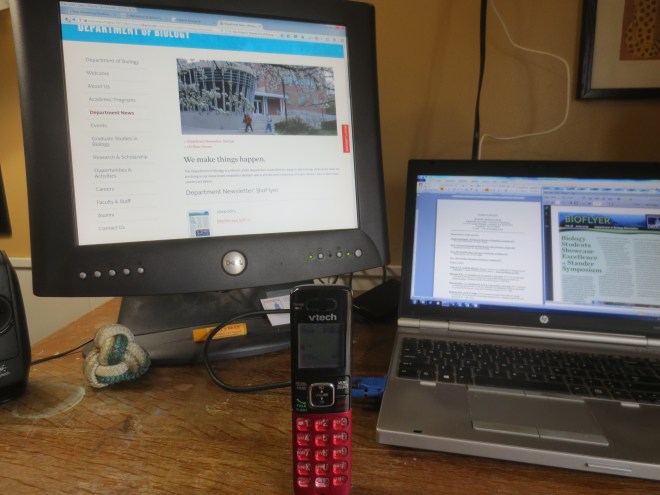
Doing well in a phone interview is a standard part of landing a job in the Sciences and is especially common and important in academia.  The process can be nerve wracking, so I thought I would share a few observations and tips from the phone interviews I have participated in as a search committee member.

Start with these principles:

(a) The faculty doing the interview and making the decision are volunteering their time to add work on top of an already insane schedule.   They likely care a whole lot about who is hired, but they are also super busy.  In one committee I was on, one particular faculty member came to several of the sessions sweating and out of breath from sprinting across campus…and then when it wrapped up…bolted out of the door to the next event.  C’est la vie in the Academy!

(b) The competition is fierce.  For most jobs there are many very good candidates.  It becomes a game of millimeters, not inches.  Little things get magnified and the committee making the call has no choice but to look at what might seem like minor details.

(c) There is most likely no significant agenda other than selecting a good person for the position.  When I was on the job market, I remember a lot of talk about politics in hiring, etc.  That may be the case in some instances, but more likely is that the faculty on the committee just want to make a good match between candidate and the job.

Tips

(1) Make scheduling the interview easy. 

The faculty members involved in the search have very busy lives and organizing a time when everyone is free can be damned-near impossible.    Putting together the schedule is a serious irritation under the best of circumstances.  So, as a candidate, you want to make it easy to schedule your interview time.  You can harm your candidacy by creating negativity around your application if you are pain to schedule.  It is subtle, but this is a game of millimeters!  If at all possible, just make whatever time they want happen.

(2) Do some homework about the people and place – present to them how you will fit.

Knowing a little bit about the people, institution and details of the position that you are applying to can be extremely helpful.  I have heard many times, during a discussion on who to move forward in a search, that a particular person “did their homework about us” for the phone interview.  Being able to talk a little bit about what is happening at the institution where you applied is very easy these days with the internet, etc.

The committee is dealing, on a daily basis, with the idiosyncrasies of the particular institution to which you are applying.  They are part of the fabric of the place, and are interested in adding people who will work well in this position given the mission of the institution.  They really are looking for a vision for what you might bring to the particular institution.  Now, obviously, there is much that is hidden from the candidate that can only be known after working at a place for a while, but there are some things that are obvious from the job ad and website.  A simple example- if the job has a relatively high teaching load, the faculty will be looking for this person to be excited to contribute in the classroom.  You need to paint a picture for the committee of how you would contribute as a teacher.  This may be very different than a place where the job is 80% research.

(3) Answer the questions – don’t filibuster!

Especially in interviews for research positions in Science, it is easy for a person prepping for an interview to really think through the dynamite description of their research they want to deliver on the phone.  This is useful; however, only if it neatly falls within the time frame available and within the context of what the committee is trying to accomplish in the phone interview.  The committee has your CV and maybe has even looked at some publications, etc., so your Scientific acumen has done its job…gotten you on the phone with them.  They may not be looking for an exposition on your project.  A big part of the phone interview is filling out around the science in your packet, e.g., will you make a good colleague?

I have seen instances where the committee poses a question and the candidate launches into a clearly prepared statement that ends up amounting to a filibuster.  Later, when talking about the candidate, the committee will have forgotten the content of the science ramble you went on, but they will remember that you didn’t answer the question.  Of course, if the committee asks for an exposition give it to them, just don’t force the exposition on them if they are asking other things.

(4) Stay on time.  

The committee is trying to make these phone interviews happen in a highly constricted time frame, they likely have interviews immediately following yours, and they need for the interviews to be very similar in order to fairly compare candidates.  The interviews MUST stay on time.  So you need to answer questions in a succinct fashion.  You want to give a complete answer, but you can hold on elaboration until the end.  Normally, if you do well on time you will have a chance to bring up a topic and add it in to the conversation at the end.  Running out of time is a very bad deal.  If the committee has to skip questions or otherwise go off-script because you used too much time on a particular question it can easily cost you the job.  “We did not make it through the script with him/her” is something that will come up later as a negative and maybe damage your chances.

(5) Be ready with double-edged questions of your own.

If you do a good job, and stay on time, there will likely be time at the end for you to ask questions of the committee.  While “No, I think you already answered my questions” is a fine statement and will not hurt you, it is a good idea to think carefully about questions, and have some ready in case the opportunity presents itself.  I encourage you to think about double-edged questions– these are questions that both extract information that you really want, and also communicate something about yourself.

The classic double-edged question for a faculty position is:

“Does your university have small grant funding to support undergraduate research?”

This is probably something that you want to know but also sends a very clear message that (a) you are interested in undergraduate research, (b) you are practical about what it takes to do undergraduate research = money, and (c) you are interested in doing the work to make undergrad research happen in your lab.

Another double-edged question I used when I was on the job market:

“What is available in terms of institutional support for submission of federal grants?”

Again, you are acquiring useful information and also communicating about your intentions.

(6) Try to relax and enjoy the moment.

If you enjoy the experience it is likely that you will exude a positive attitude, which is highly persuasive and will shed a positive light on the conversation.  The committee is doing this as an act of service to the Department and University, and so will enjoy the interview more if you are friendly and seem to be enjoying the experience.

Happy Hunting!

-rwm


The Pub Roar Hypothesis

In the first (of many?, and last?) of Ryan’s Obviously Unverified Speculations (ROUSs: yes they do exist), I put forth a long-held Speculation of mine which I call:

The Pub Roar Hypothesis.

I thought some day I might actually test this hypothesis in some kind of study, but today I jettison that thought and simply outline it here: it will remained Obviously Unverified!

I speculate that by playing music at the start of class, specifically non-verbal smooth/background music that people (including me) will relax as they enter the room.  I only play things I care about personally: Zoe Keating, Bill Laswell, Miles Davis, Royksopp, Klaus Shulze are some examples).  As the number of students in the classroom increases they are prompted and encouraged to chat by the relaxing sounds- this is an Unverified Speculation, but I have observed this.

My strategy is to then slightly push the volume of the music up, as the student number in the classroom before start of class grows, the volume of their chatter grows, and I turn up the volume, and eventually…if things go well…there is a roar in the classroom.

This same phenomenon can be observed in pubs.

Music that would seem to be blaring absurdly if a single person is in the room cannot even be heard at 12:45 am when the place is jammed.  I call this, then, a “pub roar.”  I never get volumes that you would get in a pub, but the idea applies.

I Speculate that if I can get a roar going before class, brains are activated.  If you took a real time MRI of brain activity in a “roaring” classroom vs a silent one, I Speculate there would be a highly significant difference in measurable brain activity.

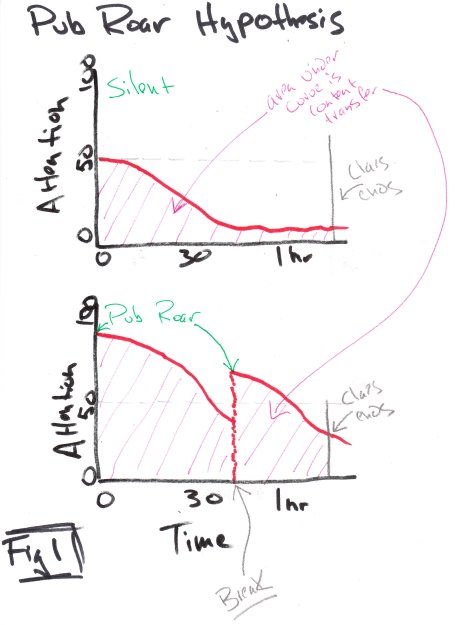
So, I like to build a good roar right before I start lecturing.  I Speculate (Figure 1) that content acquisition at the beginning of the class time, in such a classroom, will be much higher than a silent one.  I (wildly) Speculate > 70% attention to begin class vs. maybe 50% in a silent one, though that is Obviously Unverified.(Figure 1)

PubRoar

What this means is that, if you solve for the area under the curve over the first 30 minutes, for instance, in Figure 1, that there is the potential for a massively increased volume of knowledge content transfer.

Even so, attention begins to crash (in both populations: Figure 1) after about 30 minutes.  The positive effects of a pub roar “wear off” around 40 minutes in to the lecture.  That is why I nearly always take a 3-5 minute break at that point- then I begin playing music again.

This break has two benefits:  (a) if people (including me) need to pee they can, cause nobody who has to pee can concentrate well.  (b) I can usually get a little bit of a roar going again during the  break.

Normally it is quite a bit lower than the pre-class one, but if I put music back on, and walk out of the room myself, and then come back and crank the volume a little bit…I can generate a mini-roar over the course of ~ 3 minutes that, I Speculate, will drive up attention north of 50% when the lecture re-starts (Figure 1).

Then there is little enough time left in the class so that attention will remain reasonable through the end (though declining).   The break, though it costs 3-5 minutes of lecture time, I Speculate greatly increases total content transfer, especially over the last ~30 minutes of class (Figure 1).

In sum, I Speculate, that if you solve for the area under the curve, across the entirety of the class time (Figure 1), a Pub Roar classroom would have massively increased total content transfer in comparison to a silent one.  This, however, remains Obviously Unverified.
-rwm